Machine-Speed Exploitation: How Frontier AI is Redefining the Cyber Threat Landscape
We are witnessing a fundamental paradigm shift in offensive cyber operations. Artificial Intelligence is moving beyond its role as a mere “coding assistant” and is evolving into an autonomous agent capable of executing the full lifecycle of a sophisticated cyberattack. Recent hands-on evaluations by Unit 42 suggest that frontier AI models are beginning to mirror the cognitive reasoning and technical dexterity of professional, full-spectrum security researchers.
This is no longer about simple script automation; it is about autonomous vulnerability discovery. These advanced models can independently identify zero-day vulnerabilities, architect complex attack chains by linking multiple discrete weaknesses, and dynamically adapt their payloads to bypass modern, hardened defensive perimeters in real-time.
The Shrinking Window: Patching at the Speed of Thought
Perhaps the most alarming technical implication of this shift is the rapid collapse of the “patch window.” In traditional security workflows, defenders typically operate within a window of days or weeks to remediate known vulnerabilities (often referred to as N-days). AI-driven automation threatens to compress this critical timeframe from weeks to mere hours.
Consider the technical workflow of an AI-enabled adversary: An agentic model can monitor vulnerability disclosures, instantly ingest the technical details, generate a functional Proof of Concept (PoC) exploit, test that exploit against various environmental configurations, and refine the code for maximum stealth—all before an organization even begins the triage process for a patch. This effectively creates a race where the attacker is operating at machine speed, while the defender is still performing manual analysis.
This risk is disproportionately high for Open Source Software (OSS). Unit 42’s research highlights that frontier models exhibit exceptional proficiency when analyzing publicly available source code. The models can ingest large repositories, map data flows, and identify logic flaws with startling efficiency. In many testing scenarios, data is collected and routed to a Model Context Protocol (MCP) server, dropped into a datastore, and then processed by a Large Language Model (LLM) to provide a high-level, actionable intelligence summary for the human operator.
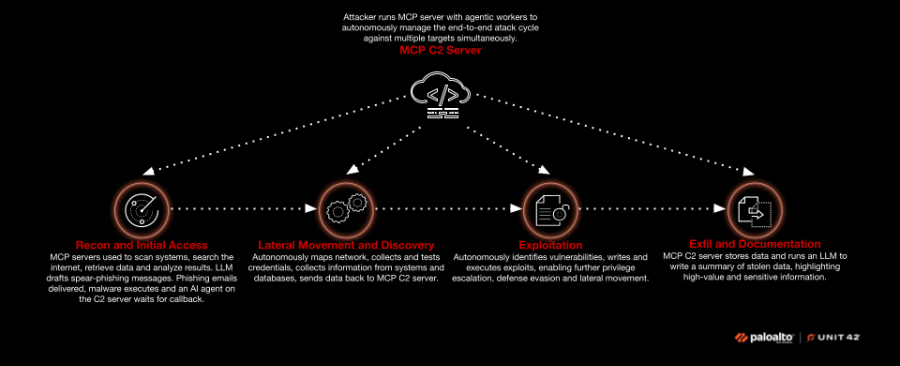
Interestingly, there is a significant disparity in how AI handles different code types. While source code is highly susceptible to AI analysis, compiled binaries show only marginal improvements in automated inspection. This creates a unique vulnerability profile for the open-source ecosystem, which serves as the foundation for much of the world’s commercial software. A single vulnerability in a widely utilized library can be weaponized by AI to trigger massive, automated supply chain attacks, echoing the devastating impact of historical JavaScript library compromises.
The AI Force Multiplier: A Lifecycle View
AI does not just find bugs; it optimizes every stage of the kill chain. When weaponized, an AI-driven campaign functions as a massive force multiplier, allowing a single actor to manage high-concurrency attacks across diverse targets:
- Reconnaissance: Autonomous agents scrape public datasets, social media, and technical repositories to build highly accurate target profiles and technology stacks.
- Initial Access: LLMs generate hyper-personalized, context-aware spear-phishing content that bypasses traditional linguistic red flags.
- Lateral Movement: Autonomous agents act as “digital locksmiths,” mapping internal network architectures, testing stolen credentials, and identifying paths to high-value assets.
- Exploitation: On-the-fly generation of custom exploits tailored to the specific memory offsets or environmental quirks discovered during scanning.
- Exfiltration: AI-driven analysis of stolen data sets to prioritize high-value intellectual property for extortion or black-market resale.
The Defensive Mandate: Adapting to Machine Speed
While the threat landscape is evolving, it is important to note that AI is amplifying existing tactics rather than inventing entirely new physics of warfare. The fundamental principles of cybersecurity remain valid, but the required latency of response has changed. To counter machine-speed threats, organizations must move toward an automated, proactive defense posture.
Key strategic priorities for modern security teams include:
- Assume Breach Architecture: Shifting focus from perimeter defense to robust Zero Trust models and enhanced endpoint detection and response (EDR).
- Software Transparency: Implementing comprehensive Software Bills of Materials (SBOMs) to gain visibility into the deep dependencies of the software supply chain.
- Automated Patch Management: Reducing the human-in-the-loop requirement for deploying critical security updates.
- DevSecOps Integration: Hardening development pipelines and restricting unauthorized external access through automated security gates.
- AI-Augmented Defense: Deploying AI-driven security orchestration, automation, and response (SOAR) tools to match the speed of the adversary.
The long-term outlook is a digital arms race. The same transformative power of AI that empowers an attacker can be harnessed by defenders to predict, detect, and remediate vulnerabilities before they can be exploited. However, in the immediate term, success will be measured by how quickly security professionals can integrate automation into their own workflows to meet the rising tide of machine-speed exploitation.