Rewriting History: Uncovering fast16, the Pre-Stuxnet Sabotage Framework
For years, the cybersecurity community has looked to Stuxnet as the gold standard for high-impact, state-sponsored cyber sabotage. However, recent intelligence from SentinelLABS has fundamentally shifted our understanding of the cyber-weapons timeline. Researchers have uncovered a previously undocumented framework known as fast16, with core architectural components dating back to 2005—predating the infamous Stuxnet worm by at least five years.
Fast16 is not a traditional data-exfiltration tool; it is a precision instrument of sabotage designed to compromise the integrity of scientific and engineering computations.
Technical Architecture: The Dual-Component Engine
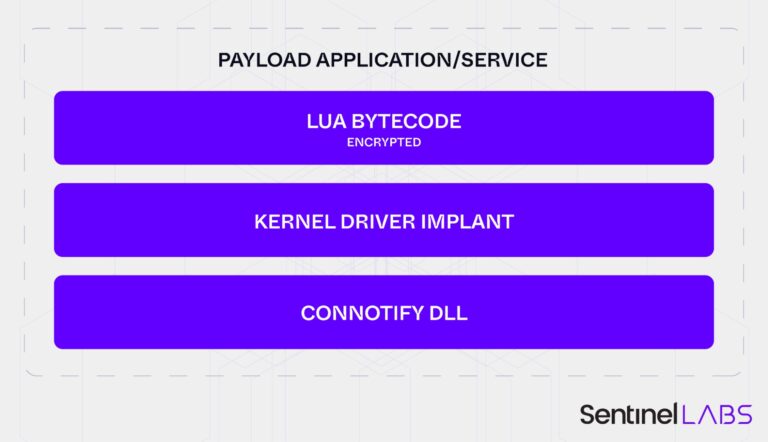
The framework operates through a sophisticated two-pronged approach, combining a high-level management service with a low-level kernel manipulator:
- svcmgmt.exe: A Lua-powered service binary that acts as the framework’s orchestrator. It stores three distinct payloads, including encrypted Lua bytecode used for complex configuration management.
- fast16.sys: A highly privileged kernel driver that functions as a boot-start filesystem component. This driver is the “muscle” of the operation, intercepting and modifying executable code in transit as it is read from the disk into memory.
By operating at the kernel level, fast16 can perform “on-the-fly” patching, ensuring that the malicious modifications only exist in the running process memory, making traditional disk-based forensics significantly more challenging.
Strategic Targets: Sabotaging the Laws of Physics
While most malware seeks to steal secrets, fast16 seeks to corrupt truth. The framework specifically targets high-precision calculation software—tools used for advanced physics, cryptographic modeling, and nuclear research. Analysis shows a specialized rule-driven patching engine containing 101 distinct rules for pattern matching, specifically optimized for binaries compiled with the Intel C/C++ compiler.
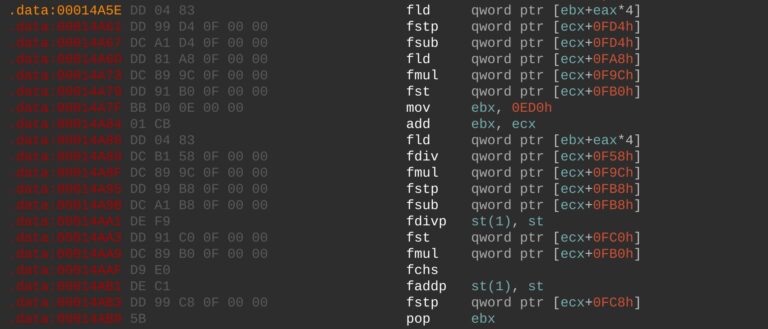
The malware contains specialized Floating-Point Unit (FPU) instructions designed to intercept and degrade precision arithmetic routines. By introducing systematic, subtle errors into these calculations, an attacker can cause catastrophic real-world failures in engineered systems or derail years of scientific research without the victim ever realizing their data has been compromised.
SentinelOne identified three primary software targets likely to be running in high-value environments:
- LS-DYNA 970: Essential for structural analysis and crash testing.
- PKPM: Widely used Chinese structural engineering software.
- MOHID: A high-end hydrodynamic modeling platform.
The ShadowBrokers Link and Geopolitical Context
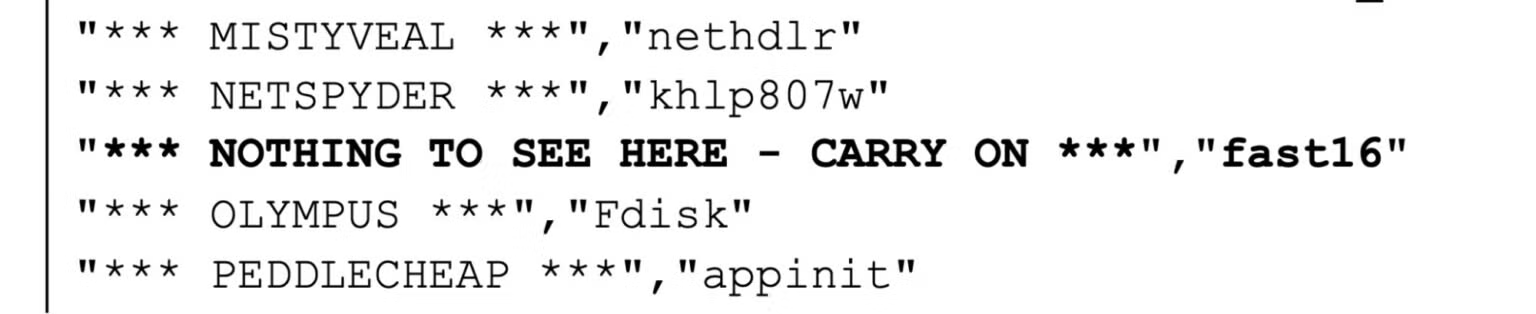
The historical significance of fast16 is deepened by its appearance in the 2017 ShadowBrokers leak, which released components of the NSA’s “Territorial Dispute” toolkit. Within those leaks, a deconfliction signature was discovered: “fast16 * Nothing to see here – carry on *”.
Furthermore, since public intelligence has frequently linked the use of LS-DYNA software to nuclear weapons research in Iran, the timeline suggests that fast16 may have been deployed to target Iranian nuclear programs years before the world was aware of the Stuxnet era.
Engineering Sophistication: A Precursor to Modern Modular Malware
Fast16’s development sophistication was unprecedented for 2005. Most notably, it utilizes an embedded Lua 5.0 virtual machine to achieve modularity—a technique that would not become common in sophisticated malware like Flame until three years later.
Key defensive evasion and propagation features include:
- Environmental Awareness: The malware performs checks for security products and will abort its deployment if it detects a monitored or “noisy” environment.
- Wormable Propagation: Rather than using complex new protocols, fast16 leveraged standard Windows service-control and file-sharing APIs. By exploiting weak or default passwords on Windows 2000 and XP systems, it could spread across an entire facility, ensuring that the corrupted calculations were consistent across all nodes, making independent verification nearly impossible.
Indicators of Compromise (IoCs)
Security professionals should monitor for the following artifacts associated with the fast16 framework:
| Driver Component | |
|---|---|
| Name | fast16.sys |
| MD5 | 0ff6abe0252d4f37a196a1231fae5f26 |
| SHA1 | 92e9dcaf7249110047ef121b7586c81d4b8cb4e5 |
| SHA256 | 07c69fc33271cf5a2ce03ac1fed7a3b16357aec093c5bf9ef61fbfa4348d0529 |
| Library Component | |
|---|---|
| Name | connotify.dll |
| MD5 | 410eddfc19de44249897986ecc8ac449 |
| SHA1 | 675cb83cec5f25ebbe8d9f90dea3d836fcb1c234 |
| SHA256 | 8fcb4d3d4df61719ee3da98241393779290e0efcd88a49e363e2a2dfbc04dae9 |
| Service Component | |
|---|---|
| Name | svcmgmt.exe |
| MD5 | dbe51eabebf9d4ef9581ef99844a2944 |
| SHA1 | de584703c78a60a56028f9834086facd1401b355 |
| SHA256 | 9a10e1faa86a5d39417cae44da5adf38824dfb9a16432e34df766aa1dc9e3525 |
The discovery of fast16 serves as a stark reminder that the era of sophisticated, state-sponsored digital sabotage began much earlier than we previously thought. It forces a complete re-evaluation of the historical landscape of cyber warfare.