Supply Chain Breach: Malicious Code Injected into Bitwarden CLI via CI/CD Pipeline Exploitation
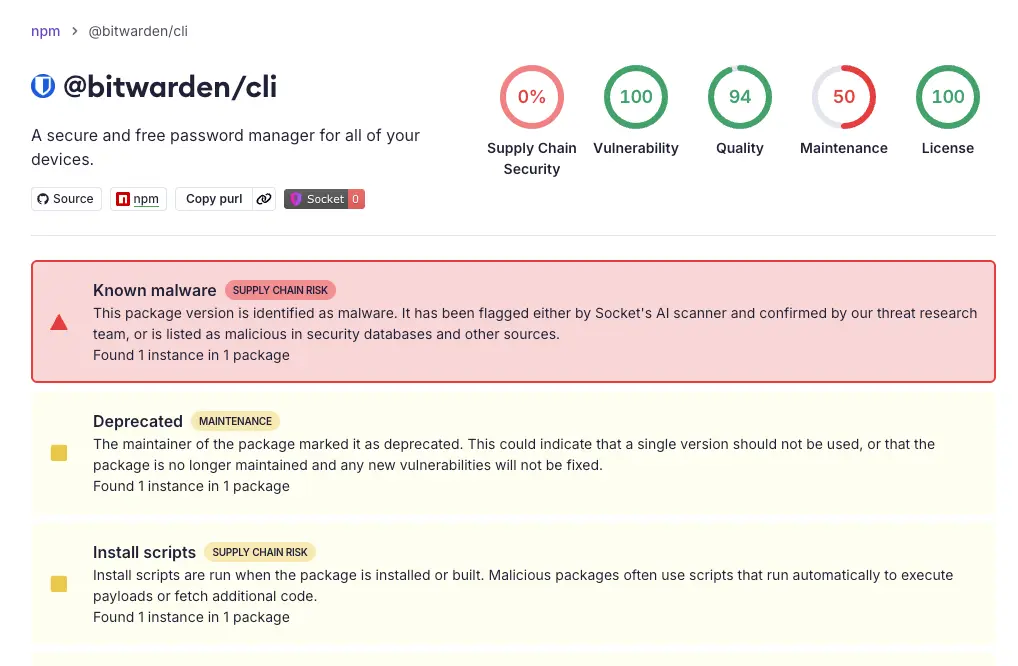
In a sophisticated demonstration of modern supply chain vulnerability, cybersecurity researchers at Socket have identified a critical compromise affecting the Bitwarden CLI. This wasn’t a simple case of credential theft; rather, attackers successfully weaponized the software development lifecycle itself by abusing a GitHub Action within Bitwarden’s CI/CD orchestration pipeline.
By hijacking this automated workflow, the threat actors were able to inject a malicious payload directly into the official npm package distribution. This incident appears to be a localized execution of the broader, highly organized Checkmarx supply chain campaign, targeting developers through their most trusted tools.
Technical Analysis: The @bitwarden/cli Compromise
The technical footprint of this attack is centered on @bitwarden/cli version 2026.4.0. Detailed forensic analysis revealed a hidden malicious script embedded within a file named bw1.js. It is important to note that this breach is currently isolated to the npm package for the command-line interface; Bitwarden’s browser extensions and desktop applications remain unaffected by this specific injection.
While the malware utilizes the same command-and-control (C2) infrastructure seen in recent Checkmarx-related attacks, its operational logic is uniquely aggressive. Once the infected package is installed, the script initiates a high-speed credential harvesting routine, targeting the most sensitive areas of a developer’s local environment:
- Memory Scraping: Attempting to extract ephemeral secrets from active processes.
- Environment Variable Exfiltration: Targeting high-value tokens such as GitHub PATs (Personal Access Tokens).
- Cloud Infrastructure Credentials: Systematic harvesting of AWS, Azure, and GCP identity keys.
- Configuration Theft: Accessing
.npmrcfiles and SSH private keys to facilitate further lateral movement.
Anomalous Behaviors: “Dune” Branding and Geofencing
What distinguishes this payload from standard malware is its highly idiosyncratic behavior. The attackers implemented a Russian locale kill switch; the malicious routines are programmed to terminate immediately if they detect a system locale or environment variable starting with “ru,” likely to avoid scrutiny from regional authorities.
Furthermore, the exfiltration method is surprisingly theatrical. Instead of traditional POST requests to a hidden server, the malware leverages the victim’s own identity to leak data. It automatically creates public GitHub repositories, using “Dune” franchise-themed naming conventions involving terms like “fremen,” “sandworm,” or “mentat.” These repositories often contain a “Butlerian Jihad” manifesto in the description, adding a layer of ideological branding to the theft.
To ensure persistence, the payload modifies shell profiles (such as .bashrc or .zshrc) and employs a hardcoded lock file mechanism to prevent multiple instances of the malware from causing system instability or detection through resource spikes.
Incident Response and Mitigation Strategy
If your organization utilizes the Bitwarden npm package, you must treat this as a high-severity breach of your development environment. Immediate remediation steps include:
- Immediate Quarantine: Purge
@bitwarden/cliversion 2026.4.0 from all local developer machines and CI/CD build runners. - Mass Credential Rotation: Rotate all secrets that touched the machine, including cloud IAM keys, GitHub tokens, npm registry tokens, and SSH keys. Assume these are compromised.
- GitHub Audit: Review your GitHub organization for any new, unauthorized repositories, specifically searching for “fremen,” “sandworm,” or “mentat” in the titles.
- Infrastructure Hardening: Move toward a “Least Privilege” model by using short-lived, OIDC-based credentials for cloud access and tightening GitHub Actions permissions.
Indicators of Compromise (IOCs)
Malicious Package Information
Package: @bitwarden/[email protected]
Malicious File: bw1.js
Network Indicators
94[.]154[.]172[.]43https://audit.checkmarx[.]cx/v1/telemetry
File System Indicators
/tmp/tmp.987654321.lock/tmp/_tmp_[unix_epoch_timestamp]/package-updated.tgz