Technical Analysis: Implementation Flaws and Data Corruption in VECT 2.0 Ransomware
VECT 2.0 ransomware presents a unique challenge to incident responders: even when the attacker’s own decryptor is deployed, the resulting files are often irrecoverable. While previous research highlighted a fundamental cross-platform design flaw involving the discard of nonces during the processing of large files, deep-dive analysis into the Windows-specific implementation reveals a broader spectrum of execution errors that exacerbate data loss.
These architectural and programmatic failures result in a chaotic post-encryption state where files may be renamed but remain in plaintext, partially encrypted, or structurally corrupted in ways that defy standard decryption logic.
Investigators focused on a 64-bit Windows Portable Executable (PE) sample identified as VECT 2.0. By performing differential analysis against related builds, they were able to distinguish between the core VECT cryptographic logic and the specific implementation bugs present in this Windows variant.
Targeting Logic and File Processing Flow
VECT employs an exclusion-based targeting strategy. The malware iterates through accessible directories but skips critical system paths, protected filenames, and specific executable extensions (such as .exe, .dll, and .sys) to maintain system stability during the attack. Consequently, the primary targets are high-value data assets, including business documents, PDFs, archives, databases, and virtual disk images.
A critical indicator of the attack progress is the file renaming sequence. VECT appends a .vect suffix to a file before the encryption routine begins. This creates a deceptive “false positive” for recovery efforts: the presence of a .vect extension signals that the file was targeted, but it provides no guarantee that the encryption process actually completed successfully. Files may be renamed but remain entirely unencrypted or exist in a state of partial modification.
According to Morphisec research, mitigating this threat requires a dual-pronged approach: proactive prevention to stop the execution flow and sophisticated recovery tools capable of addressing these specific file-state inconsistencies.
Cryptographic Failures and the Large-File Nonce Problem
The ransomware’s file metadata is critically underspecified. There are no magic markers, version identifiers, original file size headers, chunk tables, or authentication tags. The encryptor reuses an encryption context across multiple files while generating a fresh 12-byte nonce for each encrypted segment.
This design leads to a catastrophic failure in large-file handling. For files exceeding 128 KB, VECT partitions the file into four quadrants. It encrypts a 32 KB block at the start of each quadrant using four distinct nonces; however, it only writes the final nonce to the disk trailer. Because the preceding nonces are discarded, the decryptor lacks the necessary state to reconstruct the early encrypted regions, leaving the file structurally broken after any attempted recovery.
Critical Implementation Flaws in the Windows Build
Beyond the inherent design flaws, the Windows implementation introduces two major low-level programming errors that significantly degrade recoverability.
1. Buffer Size Mismatch and Memory Corruption
VECT’s on-disk metadata is minimal, consisting only of a 12-byte trailer containing the last ChaCha20 IETF nonce used. Our analysis identified a significant buffer-size mismatch in the single-pass encryption code path.
For files up to 0x20000 bytes (128 KB), the malware’s logic may pass the full file size to the ReadFile API, yet the actual heap-allocated encryption buffer is only 0x8000 bytes (32 KB). This discrepancy means that files between 32 KB and 128 KB are read into an undersized buffer. Depending on the runtime environment, this can lead to buffer overflows, partial encryption, or write failures that leave the file in an inconsistent, unrecoverable state.
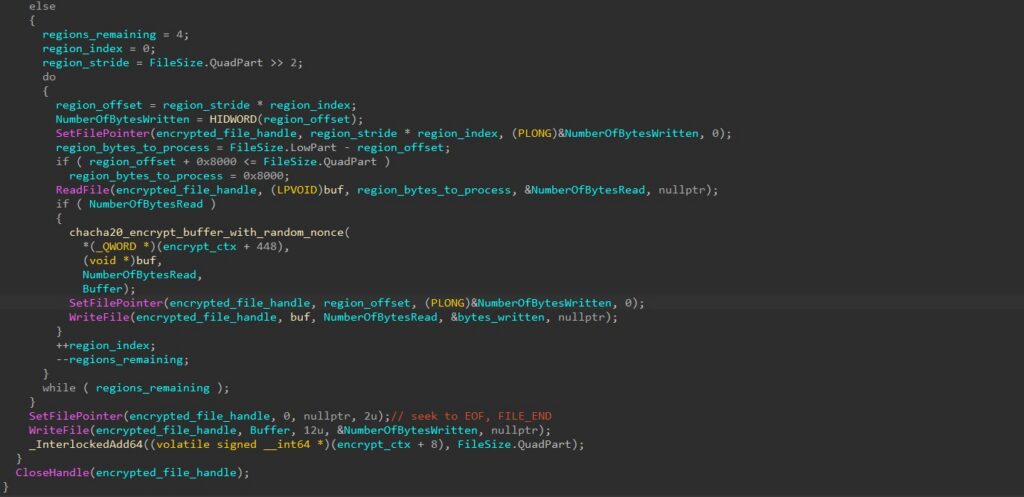
2. Multithreading Race Conditions
VECT utilizes concurrent scanner and encryptor worker threads to maximize encryption velocity. However, the implementation fails to maintain thread-local state. The routine responsible for constructing the .vect filename utilizes a shared path buffer, and the 32 KB content read buffer is reused across all worker threads.
Because these buffers are process-global rather than local to the thread, a race condition occurs: one worker thread can overwrite the path or data buffer while another thread is still actively processing that same memory address. These concurrency errors manifest as corrupted file contents, incorrect filenames, and unpredictable file system anomalies.
Conclusion: The Failure of Generic Decryption
The combination of design flaws and implementation bugs means that VECT 2.0 does not produce a uniform class of encrypted files. A single .vect extension could represent a file that was merely renamed, a file partially encrypted via a single pass, a large file with missing cryptographic nonces, or a file corrupted by a threading race condition.
Standard decryptors rely on the assumption of a consistent, predictable file format. When VECT violates these assumptions, recovery fails. To effectively combat VECT 2.0, organizations must move beyond generic decryption and employ advanced security solutions that can detect these edge cases in real-time and provide tailored recovery mechanisms.