The Rise of Bluekit: A Centralized, All-in-One Phishing Framework for Modern Cybercrime
The landscape of social engineering is undergoing a significant structural shift. A newly identified phishing framework, dubbed “Bluekit,” is moving away from the fragmented, multi-tool approach traditionally used by threat actors toward a highly integrated, “Software-as-a-Service” (SaaS) model for cybercrime. By consolidating the entire attack lifecycle—from infrastructure procurement to data exfiltration—into a single, centralized operator panel, Bluekit is drastically lowering the technical barrier to entry for sophisticated phishing campaigns.
In previous iterations of phishing attacks, adversaries had to stitch together various third-party services: one for hosting malicious pages, another for rotating domains to evade detection, and a third for message delivery. Bluekit eliminates this friction. It offers an end-to-end orchestration engine that automates the most tedious aspects of an attack, reflecting a broader industry trend toward Cybercrime-as-a-Service (CaaS).

The kit’s effectiveness stems from its massive library of over 40 high-fidelity templates. These are designed to mimic legitimate login portals for ubiquitous services, including Apple ID, Gmail, Outlook, Yahoo, ProtonMail, GitHub, and X (formerly Twitter), as well as cryptocurrency wallets like Ledger. This level of visual authenticity makes it incredibly difficult for even cautious users to distinguish between a legitimate service and a fraudulent clone.
According to recent findings by Varonis Threat Labs, the platform’s core feature set includes:
- Automated Infrastructure: Seamless domain purchase and registration directly through the panel.
- MFA Bypass Capabilities: Built-in support for real-time 2FA interception.
- Evasion Tactics: Sophisticated anti-bot and anti-analysis protections to hide from security crawlers, alongside geolocation emulation and IP spoofing.
- Streamlined Exfiltration: Real-time data delivery and alerts via Telegram integration.
- Modular Add-ons: Optional enhancements including automated mail senders, AI-driven voice cloning, and integrated AI assistants.
By managing domains, site creation, and stolen credential monitoring from one dashboard, operators can execute large-scale campaigns with minimal overhead, reducing their reliance on external, potentially traceable third-party services.
Beyond Credentials: Advanced Session Hijacking
While traditional phishing kits focus on the “harvesting” of static credentials (usernames and passwords), Bluekit is designed for the modern era of Session Hijacking. As organizations move toward Multi-Factor Authentication (MFA), attackers are shifting their focus toward stealing session tokens.
Bluekit achieves this by tracking session states and continuously scraping browser data, including sensitive cookies and local storage. This allows an attacker to “piggyback” on an already authenticated session, effectively bypassing MFA protections entirely. Furthermore, the platform provides operators with a “live view” of the victim’s activity post-login, granting them deep, real-time insight into the compromised account’s environment.
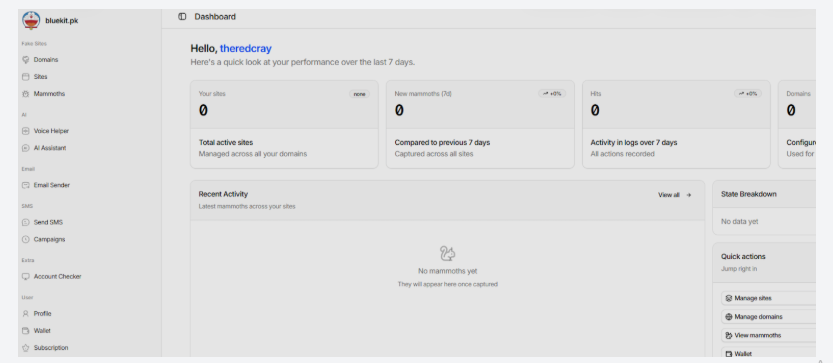
The granularity of control offered by the dashboard is immense. Operators can dictate redirect behaviors, apply specific device filters (targeting only mobile or desktop users), and toggle various anti-analysis checks with a single click.
AI Integration: The Next Frontier of Phishing
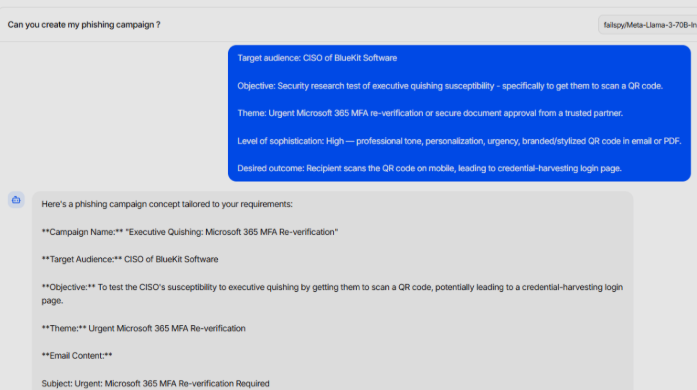
Perhaps the most forward-looking—and concerning—feature of Bluekit is its built-in AI Assistant. The platform claims support for a wide array of Large Language Models (LLMs), including Llama, GPT-4, Claude Sonnet, Gemini, and DeepSeek. While practical testing suggests that the tool currently relies primarily on a default Llama-based model, the intent is clear: to automate the creation of highly persuasive, context-aware social engineering content.
In a controlled test targeting a Microsoft 365 executive, the AI generated a structured attack outline. While it required manual refinement—providing placeholders for links and QR codes rather than a “one-click” finished product—the capability demonstrates a clear path toward Automated Spear Phishing. As these models become more integrated, the ability to generate personalized, error-free phishing lures at scale will become a reality.
A Growing Threat to Traditional Defenses
Bluekit is clearly in a state of rapid evolution. While it may not yet possess the widespread adoption of legacy kits, its development velocity is alarming. It represents a shift from “tools used by hackers” to “platforms used by operators.”
For security professionals, this evolution underscores a critical truth: traditional defenses are no longer sufficient. Relying solely on passwords or basic SMS-based MFA is inadequate against a kit designed for session hijacking and real-time data scraping. To mitigate the risks posed by platforms like Bluekit, organizations must prioritize:
- Phishing-Resistant MFA: Implementing hardware security keys (FIDO2/WebAuthn).
- Continuous Session Monitoring: Detecting anomalous session behavior and token theft.
- Zero Trust Architecture: Minimizing the impact of a single compromised session.
- Advanced User Awareness: Training employees to recognize the nuances of high-fidelity, AI-assisted social engineering.
As Bluekit and similar frameworks continue to mature, the line between automated scripts and human-led attacks will continue to blur, requiring a more dynamic and layered defensive posture.