The Rise of “Darkhub”: Analyzing a New Multi-Vector Hacking-for-Hire Marketplace
A sophisticated new player has emerged within the dark web ecosystem: Darkhub. This platform, operating via the Tor network, functions as a centralized marketplace for offensive cyber capabilities, advertising a diverse catalog of “hacking-for-hire” services aimed at both high-value organizations and private individuals.
While the platform presents a polished, professionalized interface designed to mimic a legitimate service provider, security analysts urge extreme skepticism. Historically, many such portals act as elaborate advance-fee scams—meaning they collect payments for services that are never actually rendered.
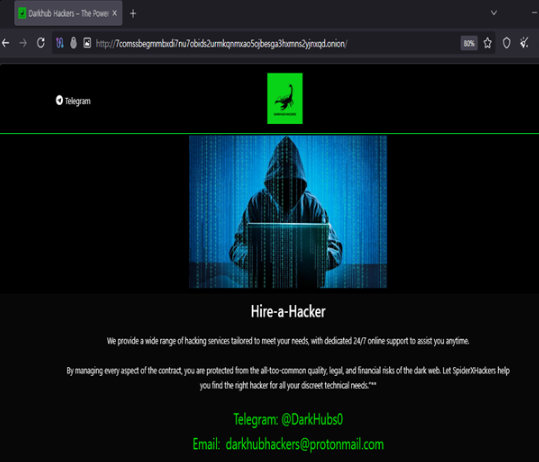
Service Offerings and Threat Vectors
Darkhub’s service menu is categorized to appeal to various malicious intents. Key offerings include:
- Account Compromise: Targeted takeover attempts for high-traffic social and communication platforms, including Instagram, Telegram, WhatsApp, and primary email accounts.
- Surveillance & Espionage: Capabilities claiming mobile device monitoring, real-time communication tracking, and message interception.
- Geolocation Services: Promises of both real-time and historical location tracking of specific targets.
- Financial Fraud: Unauthorized access to banking credentials and specialized cryptocurrency-related fraud services.
Security researchers examining the site note that while these portals often claim high-tier technical capabilities, their actual operational success is nearly impossible to verify through traditional means. Notably, the inclusion of “credit score manipulation” and “fund recovery” services is a major red flag. These latter services are frequently used to target secondary victims—individuals who have already lost money to fraud and are looking for help, only to be scammed a second time.
The platform is currently accessible via the onion domain: 7comssbegmmbxdi7nu7obids2urmkqnmxao5ojbesga3hxmns2yjnxqd.onion.
Infrastructure Analysis: Leaks in the Anonymity Layer
Despite the platform’s reliance on the Tor network for anonymity, intelligence gathered via the Arthur dark web platform has revealed a potential weakness in their operational security (OPSEC). Researchers identified a publicly routable IP address linked to the service, suggesting that the backend infrastructure may not be fully isolated from the clear web.

The identified IP (38.127.*.*) is hosted by ULTAHOST (ASN AS44259), a US-based provider. The existence of a public-facing IP increases the potential attack surface for the operators, as it provides a direct path for investigators to attempt to map the backend architecture.
ULTAHOST has been frequently cited by security firms, such as Bolster AI, for exhibiting characteristics common to “bulletproof hosting”—providers that offer permissive content policies and offshore-style operations to attract threat actors seeking to evade law enforcement. While hosting malicious content does not automatically imply provider complicity, the provider has previously been referenced in ICANN compliance notices regarding phishing abuse.
Operational Evolution
Telemetry shows that the IP address associated with Darkhub has historically been fluid, undergoing multiple changes before stabilizing around January 12, 2026. This pattern—characterized by frequent migration followed by a period of stability—often indicates an operator “tuning” their infrastructure, migrating between providers to test resilience, or attempting to shake off previous digital footprints.
Conclusion: A Hybrid Threat Model
Darkhub represents a sophisticated evolution in the underground cybercrime economy. It is a hybrid threat model where genuine (albeit illicit) cybercrime services coexist with predatory fraud schemes. For security professionals and individuals alike, the takeaway is clear: platforms like Darkhub are designed to exploit trust, whether they are targeting a victim’s data or the wallet of an aspiring “hacker.”