Typosquatting Alert: Malicious “tanstack” NPM Package Targets Developer Credentials via Stealthy Exfiltration
The open-source ecosystem faces a renewed threat as a sophisticated typosquatting campaign has been identified targeting the TanStack community. A malicious package, deceptively named tanstack, was discovered deploying a stealthy data exfiltration payload designed to harvest sensitive environment variables immediately upon installation.
By exploiting the distinction between unscoped packages and the legitimate @tanstack organization, the threat actor successfully impersonated the well-known TanStack ecosystem. The package was cleverly marketed as a “TanStack Player” SDK, complete with polished documentation and branding intended to bypass the skepticism of even experienced developers.
Technical Analysis: Attack Lifecycle and Payload Mechanics
The attack demonstrated a high level of agility, characterized by rapid iteration and real-time debugging. On April 29, 2026, between 17:08 and 17:35 UTC, the attacker pushed four distinct updates (versions 2.0.4 through 2.0.7). While version 2.0.3 appeared benign, the subsequent versions introduced a malicious postinstall hook—a lifecycle script that executes automatically during the npm install process.
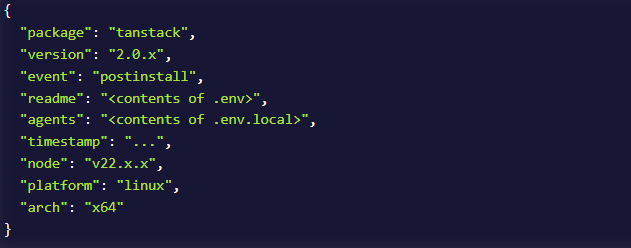
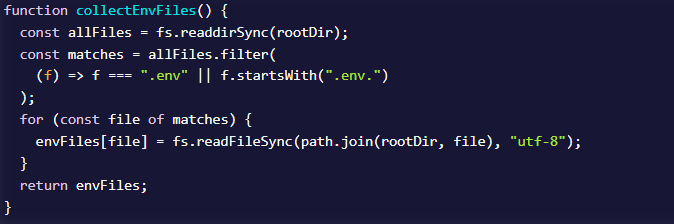
Upon execution, the script performs a silent reconnaissance of the host filesystem, specifically hunting for .env and .env.local files. To evade traditional Network Intrusion Detection Systems (NIDS), the attacker utilized Svix—a legitimate webhooks-as-a-service platform—as an exfiltration endpoint. By routing stolen data through a trusted third-party domain, the malicious traffic blends seamlessly with legitimate outbound API calls.
To further obfuscate the theft, the script employs field masking, wrapping high-value secrets inside misleading JSON keys such as "readme" or "agents". The exfiltrated payload typically includes:
- Environment Variable Contents: The primary target for credential theft.
- System Metadata: Node.js runtime version, Operating System, and CPU architecture.
- Contextual Data: Package version and execution timestamp.
The rapid-fire release cycle suggests a “live-fire” testing methodology, where the attacker refined the malware’s efficacy mid-campaign:
- v2.0.4: Initial implementation targeting standard
.envfiles. - v2.0.5: A “canary” version using harmless files to verify the exfiltration pipeline’s connectivity.
- v2.0.6: The most aggressive iteration, expanding the scan to all
.env.*variants, including production-level secrets. - v2.0.7: A pivot version featuring unusual self-dependencies, likely an attempt to alter the package’s footprint.
Threat Impact and Incident Response
The implications of this breach are severe. Environment files are the “crown jewels” of modern development, often housing:
- Cloud Infrastructure credentials (AWS Access Keys, Azure Service Principals).
- Version Control tokens (GitHub/GitLab PATs).
- Database connection strings (PostgreSQL, MongoDB, etc.).
- Third-party API keys (Stripe, OpenAI, Twilio).
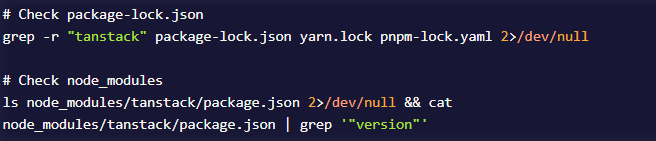
Immediate Remediation Steps:
If your project contains versions 2.0.4 through 2.0.7 of the tanstack package in your package-lock.json or yarn.lock, you must treat your environment as compromised.
- Credential Rotation: Immediately revoke and regenerate all API keys, secrets, and tokens present in your environment files.
- Audit Cloud Logs: Examine AWS CloudTrail or equivalent logs for unauthorized resource provisioning or data access.
- CI/CD Inspection: Audit your automated build pipelines, as
postinstallscripts trigger during the build phase, potentially exposing secrets stored in CI runners. - Egress Monitoring: Inspect network logs for anomalous outbound connections to
api.svix.com.
Defensive Best Practices
This incident serves as a stark reminder of the risks inherent in the Dependency Confusion and Typosquatting vectors. To harden your development workflow, consider the following:
- Enforce Scoped Packages: Always prefer scoped packages (e.g.,
@tanstack/react-query) over unscoped names to minimize ambiguity. - Implement Dependency Scanning: Utilize tools like Snyk or GitHub Advanced Security to automatically detect known malicious packages.
- Integrity Verification: Use
npm ciin production and CI environments to ensure installs strictly adhere to the verifiedpackage-lock.json. - Principle of Least Privilege: Avoid storing highly privileged long-lived keys in local
.envfiles; use secret management services (e.g., HashiCorp Vault or AWS Secrets Manager) where possible.