WordPress Plugin Vulnerability Enables Admin Takeover via Auth Bypass
A newly disclosed vulnerability, tracked as CVE-2026-1492, has been identified in the User Registration & Membership plugin for WordPress, exposing websites to critical authentication bypass and privilege escalation risks.
Affecting versions ≤ 5.1.2, the vulnerability allows remote attackers to gain full administrative access without valid credentials.
The affected plugin, widely used to manage user registration and membership access, contains a serious design vulnerability in trust handling between frontend and backend components.
This vulnerability arises from improper validation of user-controlled input and weak enforcement of authorization checks in AJAX-based membership workflows.
Instead of attacking login forms directly, threat actors can interact with legitimate functionalities such as membership registration to trigger backend actions that bypass authentication controls.
Once exploited, attackers gain full administrative control over the WordPress instance, enabling complete system compromise.
Technical Details
CVE-2026-1492 stems from insecure server-side logic that blindly trusts parameters received from client-side scripts.
| Attribute | Detail |
| CVE ID | CVE-2026-1492 |
| Published Date | March 3, 2026 |
| Vulnerability Type | Authentication Bypass / Privilege Escalation |
| Attack Vector | Remote (HTTP / AJAX) |
| Privileges Required | None |
| User Interaction | None |
| CVSS V4.0 Score | 9.8 – Critical |
| CWE | CWE-269 – Improper Privilege Management |
| Vulnerable Component | Membership Registration / AJAX Endpoint |
| Exploit Availability | Public |
By manipulating role parameters or membership actions, attackers can force the system to assign administrative privileges during registration.
The plugin fails to verify whether users are authorized to perform these actions, resulting in authentication bypass.
Exploitable parameters include nonce values exposed in public JavaScript files. Since the backend doesn’t properly validate them, unauthenticated users can reuse these values to send crafted requests to WordPress’s AJAX endpoint (/wp-admin/admin-ajax.php).
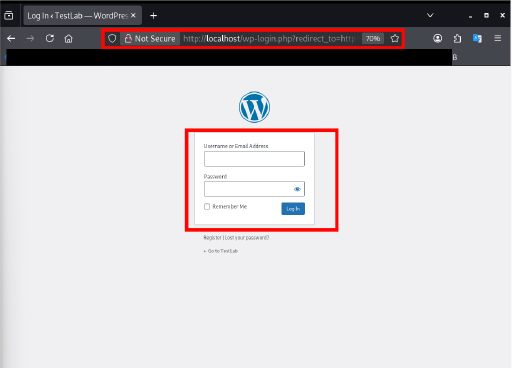
Exploitation doesn’t rely on password attacks—it abuses legitimate application behaviors, making detection challenging.
A successful attack enables attackers to:
- Modify website settings, install malicious plugins, or inject code (potential remote code execution)
- Access sensitive data, credentials, and configuration files
- Create hidden admin accounts or persistence mechanisms
- Deface websites or redirect users to phishing/malware sites
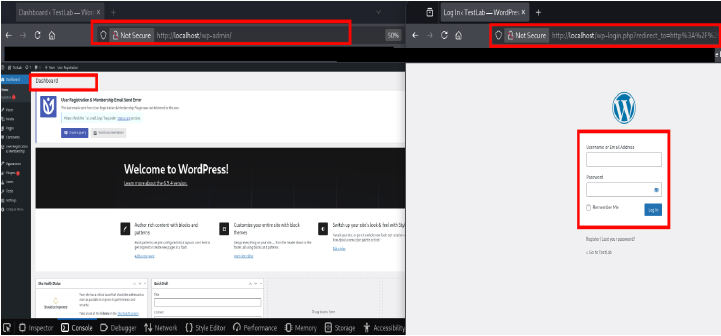
The vulnerability carries a CVSS v4 score of 9.8 (Critical) and is classified under CWE-269. Public exploit scripts are actively being weaponized.
Affected Versions and Fix
All plugin versions ≤ 5.1.2 are vulnerable. Developer version 5.1.3 implements stricter validation, enhanced authorization checks, and revised nonce handling.
Initial Access Brokers (IABs) are leveraging this vulnerability to compromise WordPress instances for resale in underground markets.
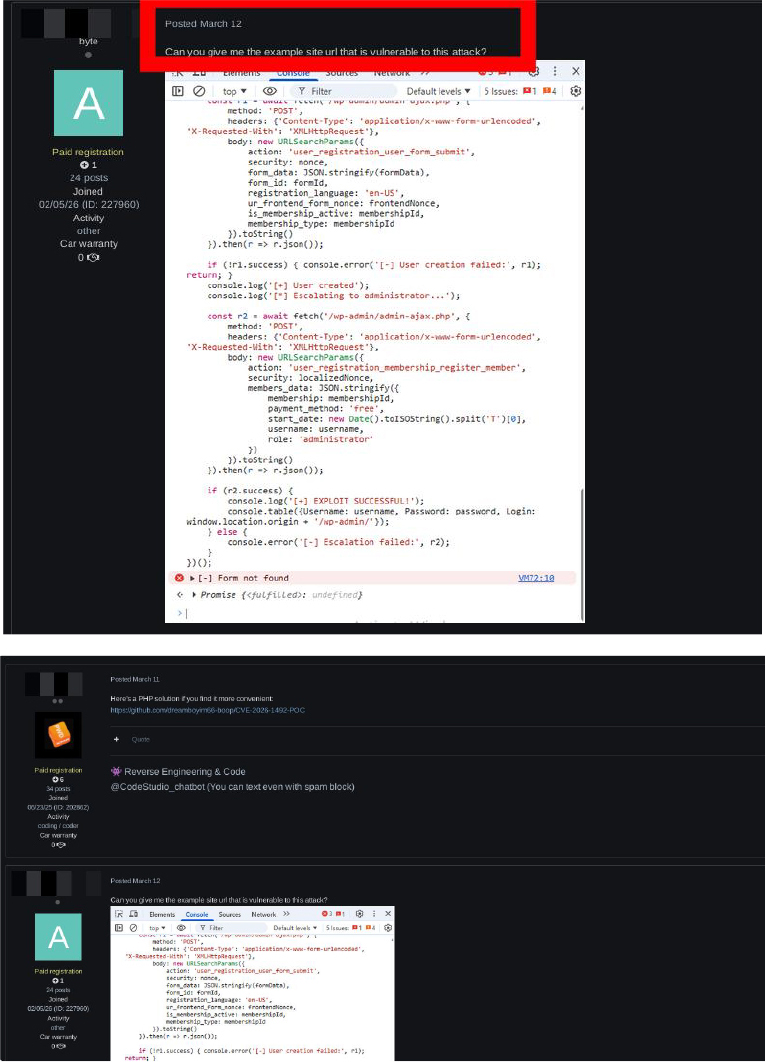
Immediate actions include:
- Update the plugin to v5.1.3 or higher
- Implement CAPTCHA validation for registration
- Monitor for abnormal AJAX requests and unexpected privilege escalations
Researchers observed widespread exploitation targeting e-commerce, education, and media sectors in North America, Europe, and Asia-Pacific regions.
CVE-2026-1492 underscores how weak frontend-backend trust validation can compromise entire WordPress systems. Patch immediately and enhance monitoring for AJAX-based membership workflows.