Advanced Persistent Threat Analysis: Kimsuky’s Multi-Vector Spear-Phishing Campaigns
The North Korean-linked threat actor, Kimsuky, has significantly evolved its operational methodology. In early 2026, the group launched a series of sophisticated spear-phishing campaigns targeting a diverse spectrum of high-value individuals, including cryptocurrency developers, defense officials, academic administrators, and recruiters.
While the thematic lures vary, the underlying technical architecture remains remarkably consistent, utilizing a structured attack chain: decoy presentation, payload deployment, persistence establishment, and Command-and-Control (C2) communication.
The group demonstrated high levels of social engineering precision by tailoring lures to specific victim profiles:
- Recruitment & Institutional Lures: Deployment of fraudulent resumes, business cards, and medical documentation.
- FinTech & Crypto Lures: Technical documentation for counterfeit Solana-based security tools aimed at developers and investors.
- Defense & Geopolitical Lures: Military competition briefings designed to compromise defense organizations and foreign attachés.
- Public Sector & Academic Lures: Disguised training documents for graduate programs targeting government employees.
A primary technical vector involves the exploitation of Windows’ default behavior of hiding file extensions. Attackers utilize LNK files disguised as PDFs and JSE scripts masquerading as Hangul (.hwpx) documents to bypass initial user scrutiny.
In several instances, Kimsuky utilized oversized LNK files that functioned as “droppers.” These files contain embedded decoy documents alongside hidden malicious payloads. Upon execution, the file displays a legitimate document to the user while simultaneously performing background operations. For example, in one campaign, a single LNK file was used to drop a decoy PDF while placing a persistence mechanism into the Windows Startup folder.
The post-exploitation phase includes downloading PowerShell scripts from C2 domains (such as nelark[.]icu), disabling User Account Control (UAC), adding exclusions to Windows Defender, and registering scheduled tasks under the guise of legitimate drivers (e.g., Intel drivers). The malware maintains a heartbeat with the C2 server every five seconds, identified by a unique victim ID.
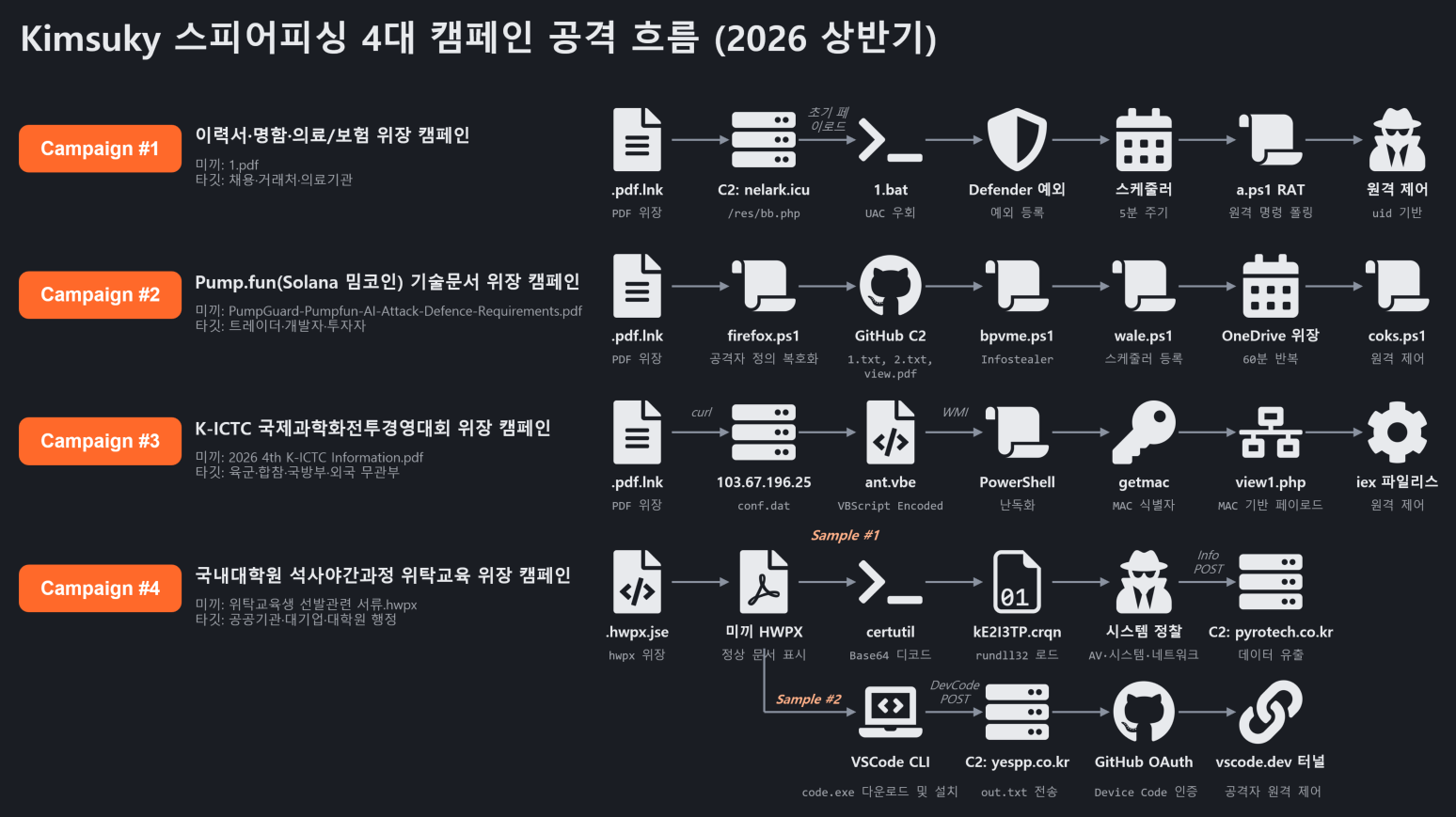
A secondary, more modular approach was observed in Campaign #4, where JSE scripts were delivered via ZIP archives. These scripts leverage “living-off-the-land” (LotL) binaries, such as certutil and rundll32, to decode and execute DLL payloads. Most notably, the group has begun leveraging VSCode’s legitimate tunneling feature to establish highly resilient, authenticated remote access through GitHub sessions.
Living off Trusted Services: The C2 Evolution
According to recent intelligence from Logpresso, Kimsuky is increasingly adopting a “living off trusted services” strategy. By utilizing reputable platforms for C2 infrastructure, they effectively blend malicious telemetry with legitimate enterprise traffic, making signature-based detection nearly impossible.
- GitHub: Utilized to host malicious payloads and exfiltrate system data via raw URLs.
- Microsoft CDN: Used to distribute legitimate VSCode binaries to facilitate the tunneling technique.
- VSCode Tunnels: Provides an encrypted, authenticated channel for remote command execution.
- Legacy Infrastructure: Traditional C2 IPs (e.g.,
103.67.196.25) are still utilized alongside these modern cloud services.
To ensure evasion, the group employs advanced obfuscation, including Base64 encoding, environment variable substitution, and the use of randomized, animal-themed variable names. Furthermore, they implement environment-keyed payloads. In Campaign #3, payloads were dynamically generated based on the victim’s MAC address, ensuring the malware remains inert if analyzed in a standard sandbox environment.
Defensive Recommendations & Behavioral Indicators
As Kimsuky moves away from static Indicators of Compromise (IoCs) toward dynamic, adaptive tactics, defenders must pivot toward behavioral detection. Organizations should monitor for the following indicators:
- Anomalous LNK Files: Execution of LNK files exceeding 10 KB that contain embedded data.
- Suspicious PowerShell Activity: Use of the
-WindowStyle Hiddenflag orDownloadStringmethods. - Task Scheduler Abuse: Creation of scheduled tasks with names mimicking system services (e.g., OneDrive, Intel, or Windows Update) that execute at irregular intervals.
- Binary Abuse: Unusual invocation of
certutil,rundll32,wscript, orcurlfor network communication. - Network Telemetry: Unexpected outbound POST requests to GitHub raw URLs or unauthorized VSCode tunnel connections.
To mitigate these risks, it is critical to enforce strict execution policies for scripts, implement robust process relationship monitoring, and increase visibility into outbound connections to developer-centric cloud platforms.