Analyzing the Critical Groovy-Based RCE in Apache Syncope (CVE-2025-57738)
The Technical Breakdown: Breaking the Sandbox That Didn’t Exist
The flaw resides within the platform’s ImplementationManager. In various versions—specifically all 2.x builds, 3.x prior to 3.0.14, and 4.x prior to 4.0.2—the system utilizes a bare GroovyClassLoader to compile dynamic code. Crucially, this implementation lacks a security sandbox, a formal CompilerConfiguration, or any form of Abstract Syntax Tree (AST) restrictions.
An authenticated administrator (or a compromised account with implementation privileges) can upload a malicious Groovy class. The “smoking gun” here is the use of a static { } initializer block. In the Java/Groovy lifecycle, static initializers are executed at the moment the class is loaded and defined. Because the GroovyClassLoader.parseClass() method triggers this execution during the compilation phase, the malicious code runs before the system has a chance to perform any interface validation or business logic checks.
This gives an attacker unrestricted access to the full Java Virtual Machine (JVM) API surface. By injecting payloads that call Runtime.exec(), ProcessBuilder, or java.net.Socket, an attacker can command the underlying host. In containerized environments where the Syncope process is running with root privileges, this effectively results in a total system takeover.
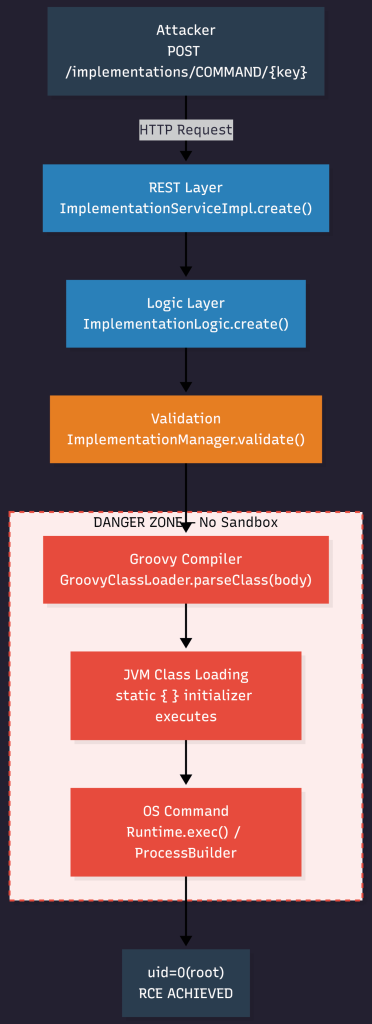
Architecturally, this is a textbook case of CWE-653: Improper Isolation or Compartmentalization. The failure is three-fold: the absence of a compiler configuration to restrict syntax, the failure to account for the side effects of static initializers, and the unintended inheritance of full JVM privileges during the class-loading process.
Exploitation in the Wild
Following the technical disclosure on April 20, 2026, researcher yosef0x01 released a functional Proof-of-Concept (PoC) on GitHub. The exploit follows a streamlined path:
- Authenticate to the Syncope REST API.
- Craft a Groovy payload containing the malicious static block.
- Upload the payload via
POST /syncope/rest/implementations/COMMAND/{key}.
Even if the server returns an error response due to a failed validation later in the process, the “damage” is already done: the code has already executed. Real-world testing has successfully demonstrated the ability to return uid=0(root), proving full container breakout or system-level access.
Remediation and Defense-in-Depth
The Apache Software Foundation has responded by implementing a robust, multi-layered defense mechanism. In Syncope 3.0.14 and 4.0.2, the platform moves away from the “naked” class loader and integrates a sandbox inspired by the Jenkins Script Security infrastructure.
The new security posture includes:
- SecureASTCustomizer: To restrict the actual structure of the code being written.
- SandboxTransformer: To rewrite code on the fly to ensure it stays within bounds.
- Runtime Blacklisting: Explicitly blocking high-risk APIs such as
ProcessBuilder,File,Socket, and various reflection methods.
Immediate Actions for Administrators:
- Patch Immediately: Upgrade to Syncope 3.0.14+ or 4.0.2+.
- Audit Permissions: Review all “delegated admin” accounts. An attacker doesn’t need full system admin rights if they have permission to manage “Implementations.”
- Credential Hygiene: Ensure default credentials (e.g.,
admin:password) have been rotated.
A Recurring Pattern?
This isn’t an isolated incident for Apache Syncope. The platform has faced a series of vulnerabilities targeting its extensibility and integration layers, including CVE-2023-26360 (SSTI) and CVE-2024-27348 (OFBiz integration issues). This recurring pattern serves as a vital reminder to developers: whenever you allow user-supplied code to be compiled at runtime, you must assume the compiler itself is an attack vector.