Strategic Vulnerabilities: The Geopolitical Weaponization of Water and Wastewater Infrastructure
Modern water and wastewater utilities have transitioned into high-value strategic targets within the “gray-zone” of international conflict. Driven by decades of chronic capital underinvestment and insufficient defensive postures regarding Operational Technology (OT), these systems present an asymmetric advantage to state-sponsored actors from Russia, China, and Iran. By targeting these utilities, adversaries can achieve significant political leverage and public psychological impact without necessitating a full-scale kinetic engagement.
The technical attack surface is characterized by high-risk vulnerabilities: internet-facing Human-Machine Interfaces (HMIs), exposed Programmable Logic Controllers (PLCs), the continued use of factory-default credentials, and a fundamental lack of robust IT/OT network segmentation. These flaws provide low-cost entry points that yield disproportionately high consequences, ranging from chemical imbalances affecting public health to the total erosion of institutional trust.
Recent intelligence and advisories from the Cybersecurity and Infrastructure Security Agency (CISA), the FBI, the NSA, and the EPA signal a paradigm shift. We are moving away from era of opportunistic, “nuisance-level” cybercrime toward deliberate, state-aligned campaigns designed for strategic coercion.
Iranian-Linked Actors: Symbolic Disruption
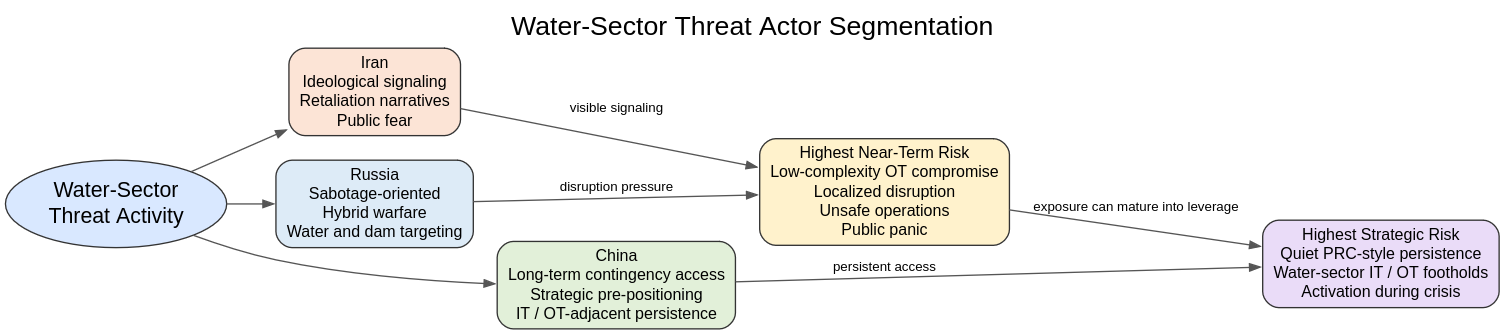
Iranian threat actors, specifically IRGC-affiliated groups such as CyberAv3ngers, have demonstrated a pattern of exploiting exposed PLCs and weak authentication protocols to deface HMIs. These operations often serve as “capability signaling”—demonstrating to the target nation that critical control systems are accessible. Technical reporting has specifically highlighted the exploitation of widely deployed Unitronics Vision Series devices and similar industrial controllers.
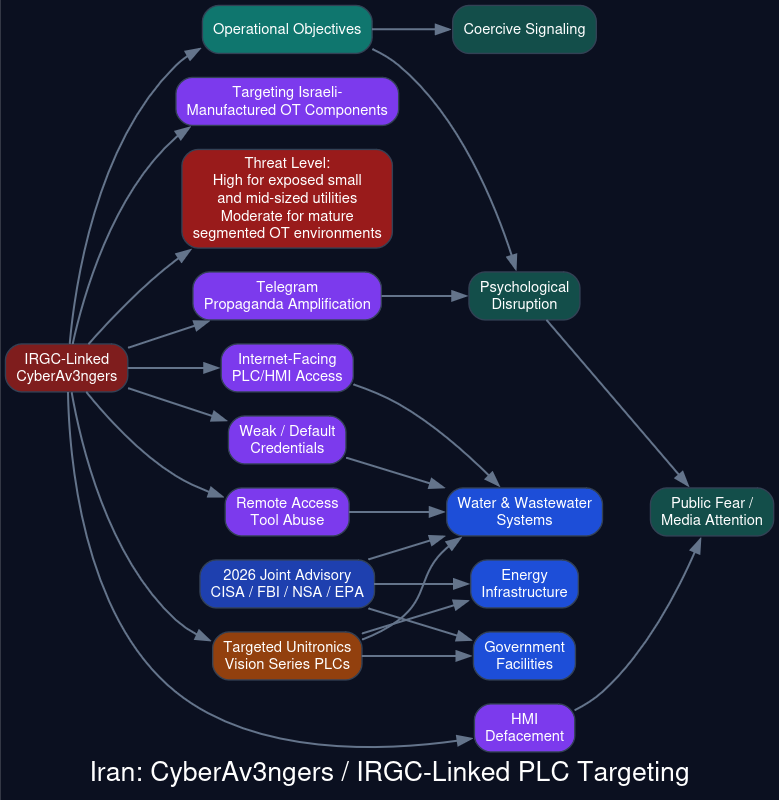
While these intrusions often prioritize symbolic signaling over catastrophic physical destruction, they validate a critical reality: minor configuration errors can grant attackers tactical control over essential physical processes.
Russian Actors: Sabotage and Hybrid Warfare
In contrast to the signaling approach, Russian and pro-Russian actors exhibit a more aggressive, sabotage-oriented methodology. Throughout the 2024–2025 period, incidents involving the manipulation of municipal water systems have resulted in tangible physical effects, such as tank overflows and the unauthorized opening of floodgates. These actions align with Moscow’s broader hybrid warfare playbook of using technical disruption to test civilian resilience and incite public alarm.
According to research from Domaintools, GRU-linked operations have demonstrated a willingness to utilize OT access for direct disruption, often employing relatively unsophisticated techniques to achieve high-impact results against poorly defended municipal targets.
The Divergent Doctrine of the People’s Republic of China (PRC)
The Chinese approach differs fundamentally from both Iran and Russia. Campaigns led by actors such as Volt Typhoon focus on long-term strategic persistence rather than immediate disruption. Their objective is “pre-positioning”—the establishment of durable, stealthy access within U.S. critical infrastructure networks, including water utilities.
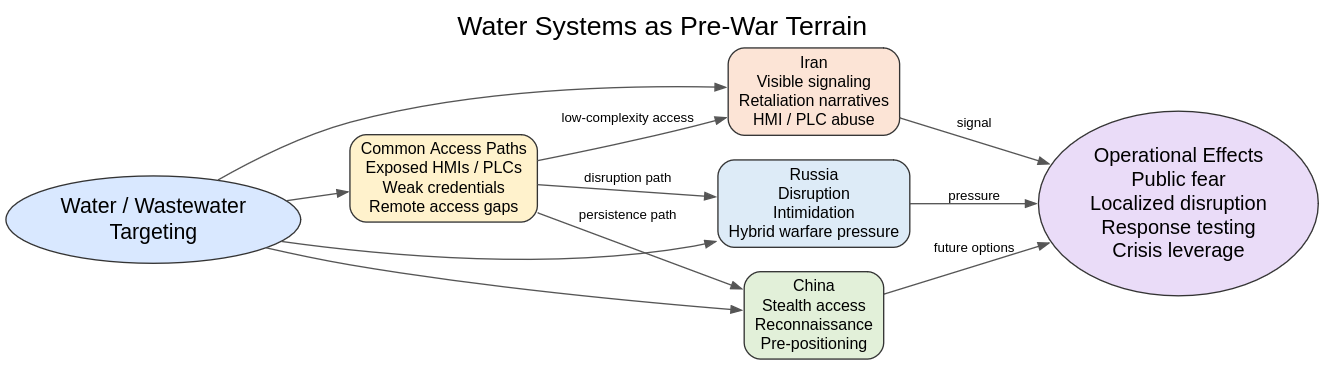
The goal of these operations is to create “contingency options.” By embedding themselves within these networks now, the PRC ensures it has the capability to trigger widespread disruption during a future geopolitical crisis, materially altering the strategic calculus of allied nations.
The Intersection of Criminal and State Activity
The fragility of the sector is further exacerbated by non-state criminal actors. Ransomware attacks on administrative interfaces, billing systems, and backup servers have frequently forced utilities to revert to manual operations. A key takeaway for operators is that bespoke ICS-specific malware is not a prerequisite for operational paralysis; credential theft and compromised vendor remote-access tools are often sufficient to move laterally from IT environments into critical OT adjacencies like GIS and identity management systems.
Regional Risk and Systemic Vulnerabilities
Geographically, the risk is acute in under-resourced or geopolitically sensitive areas. While NATO-adjacent states in Europe face intense Russian pressure, the U.S. remains a primary target for PRC pre-positioning. Across all theaters, the technical root causes remain consistent: legacy unsupported controllers, blurred IT/OT boundaries, and insufficient network monitoring.
With approximately 170,000 water systems in the U.S. alone—each possessing wildly different levels of cyber maturity—systemic remediation is a massive undertaking. Effective mitigation requires a multi-layered approach: hardening internet-facing assets, enforcing strict credential hygiene, implementing zero-trust vendor access controls, and ensuring robust network segmentation.
Indicators of Compromise (IoCs)
| Indicator | Type | Year | Relevance |
|---|---|---|---|
135.136.1[.]133 |
IP Address | 2026 | Iranian-affiliated APT communication with Rockwell Automation / Allen-Bradley PLCs |
185.82.73[.]162 |
IP Address | 2025-2026 | Iranian-affiliated APT communication with Rockwell Automation / Allen-Bradley PLCs |
185.82.73[.]164 |
IP Address | 2025-2026 | Iranian-affiliated APT communication with Rockwell Automation / Allen-Bradley PLCs |
185.82.73[.]165 |
IP Address | 2025-2026 | Iranian-affiliated APT communication with Rockwell Automation / Allen-Bradley PLCs |
185.82.73[.]167 |
IP Address | 2025-2026 | Iranian-affiliated APT communication with Rockwell Automation / Allen-Bradley PLCs |
185.82.73[.]168 |
IP Address | 2025-2026 | Iranian-affiliated APT communication with Rockwell Automation / Allen-Bradley PLCs |
185.82.73[.]170 |
IP Address | 2025-2026 | Iranian-affiliated APT communication with Rockwell Automation / Allen-Bradley PLCs |
185.82.73[.]171 |
IP Address | 2025-2026 | Iranian-affiliated APT communication with Rockwell Automation / Allen-Bradley PLCs |
Technical Note: IP addresses and domains have been defanged (e.g., [.]). Analysts should re-fang these indicators only within secure, controlled environments.