North Korea’s Modular Malware Strategy Hides Attribution, Defies Takedowns
North Korea’s cyber operations have evolved from a monolithic structure to a modular, portfolio-style ecosystem. This design ensures resilience, making malware disposable to withstand exposure, obscure attribution, and maintain ongoing operations under pressure. Years of sanctions and law-enforcement actions have forced Pyongyang to treat every tool as expendable.
Once-static implants are now engineered with short lifespans, anticipating rapid fingerprinting and neutralization. This shift prioritizes resilience: malware is designed to be burned and replaced, while the operational framework remains largely intact.
As reported, the DPRK now manages parallel malware tracks for espionage, financial theft, and disruption. Each track uses distinct tooling, infrastructure, and risk profiles aligned with its specific mission.
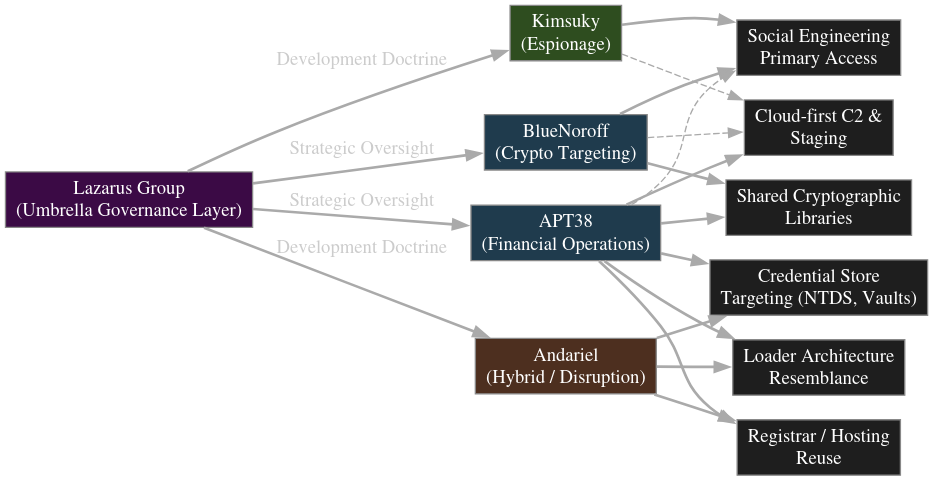
This structure limits cascading impacts when one track is compromised, allowing planners to treat compromise as routine rather than exceptional. Reporting confirms separate pipelines for Lazarus (financial), Kimsuky (espionage), and Andariel (disruption), each mapped to revenue generation, espionage, and coercive operations.
Espionage Track: Low Noise, Long Dwell
Kimsuky-led campaigns target governments, defense, academia, and policy groups for high-value, indirect information. These operations rely heavily on social engineering and tailored lures (e.g., fake VPN invoices) to deploy script-heavy loaders instead of large binaries, emphasizing stealthy access and long-term persistence.
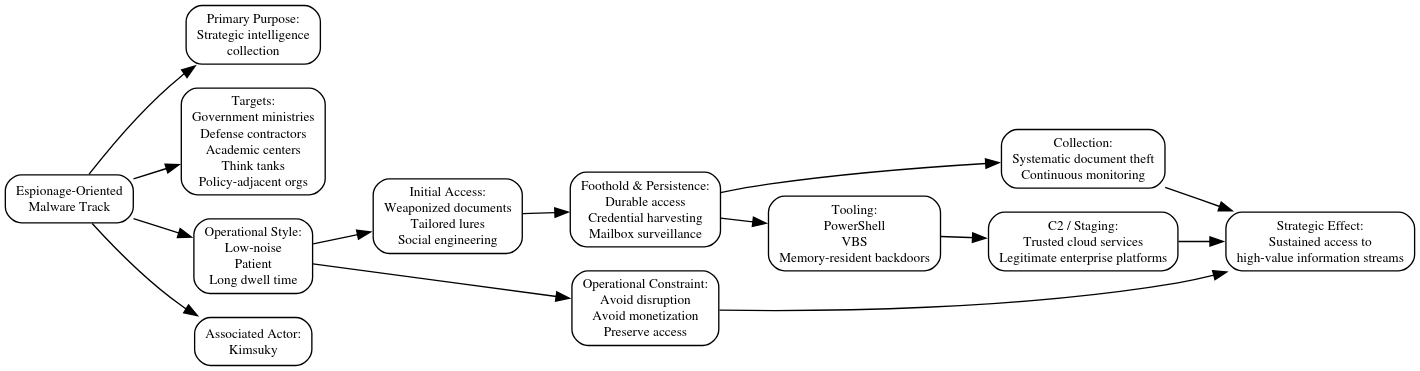
Operations leverage PowerShell and VBS chains (e.g., HttpTroy backdoors) for memory-resident access, credential theft, and mailbox surveillance, minimizing lateral movement. Operators abuse trusted cloud and collaboration platforms for C2 and staging, blending traffic into normal workflows to enable quiet, months-long collection.
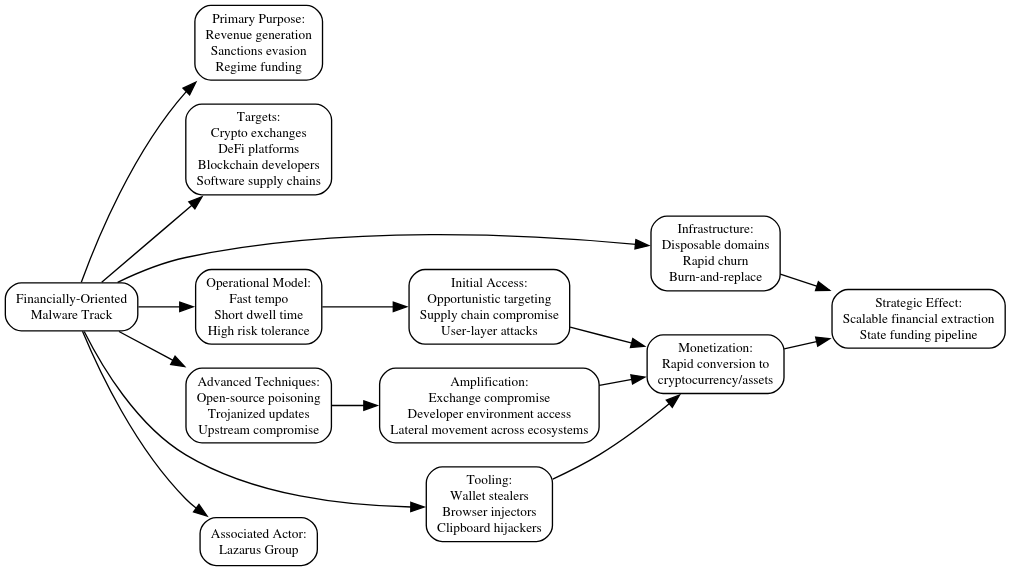
The Lazarus-led financial track prioritizes speed and yield to generate currency for sanctions evasion and weapons funding. Infrastructure is disposable: domains, VPS nodes, and web shells rotate rapidly. Tooling focuses on wallet stealers, browser injectors, and clipboard hijackers, often compromising exchanges, blockchain projects, or developer tools for broad ecosystem impact. Tool loss is acceptable if returns materialize before detection windows close.
Andariel drives a disruptive track focused on visible impact during geopolitical tension. Campaigns use ransomware-like tools, rapid lateral movement, and domain-wide execution to maximize effect before controls respond.
Despite fragmentation, technical “invariants” recur across tracks (e.g., cryptographic routines, loader designs). Infrastructure overlap exists at registrar, hosting, and certificate levels, even as front-end domains rotate. Social engineering, spear-phishing, and abuse of trusted cloud/dev ecosystems remain primary tactics across all tracks—a pattern seen in APTs like APT29, APT41, and Charming Kitten—but DPRK uniquely institutionalizes “burn-and-replace” across mission types.
For defenders, a signature/family-centric model is insufficient. Dynamic churn requires behavioral analytics, identity/access monitoring, and telemetry from cloud/dev ecosystems to detect credential abuse, anomalous movement, and trusted service abuse regardless of the malware variant.
Viewing DPRK activity solely through espionage or finance lenses risks missing parallel tracks with distinct tooling. The emerging picture is a mature, centrally coordinated cyber portfolio treating modular malware as a consumable resource, not a crown jewel engineered for sacrifice.