Operation PhantomCLR: Exploiting .NET AppDomain Mechanisms via Trusted Intel Binaries
In a sophisticated display of living-off-the-land (LotL) tactics, threat actors are hijacking the fundamental architecture of the .NET AppDomain to execute advanced malware. By weaponizing a legitimate, Authenticode-signed Intel utility, attackers are successfully bypassing traditional endpoint security and carving out a stealthy execution environment inside a trusted process. This campaign, identified by researchers as Operation PhantomCLR, specifically targets high-value financial and governmental entities across the Middle East and the wider EMEA region.
The primary engine of this attack is IAStorHelp.exe, a digitally signed Intel storage utility. Because the binary carries a valid signature from a trusted vendor, many EDR (Endpoint Detection and Response) solutions are configured to treat its execution as benign. The attackers exploit this “inherited trust” to proxy their malicious maneuvers through a process that is unlikely to trigger high-severity alerts.
Technical Deep Dive: AppDomain Hijacking via Config Poisoning
The technical crux of the attack lies in the abuse of the AppDomainManager feature. Within the .NET runtime, the AppDomain governs how application domains are initialized. By manipulating the configuration environment, attackers can intercept the startup sequence before the legitimate application logic even begins.
The delivery vector typically involves a highly targeted spear-phishing email containing a ZIP archive. This archive is a meticulously constructed package: it includes the signed IAStorHelp.exe, a malicious IAStorHelp.exe.config file, an obfuscated .NET loader DLL, an encrypted payload, and a deceptive .pdf.lnk shortcut designed to launch a decoy PDF.
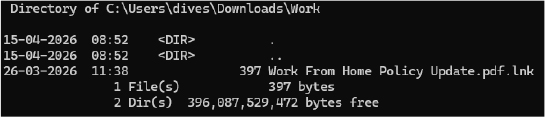
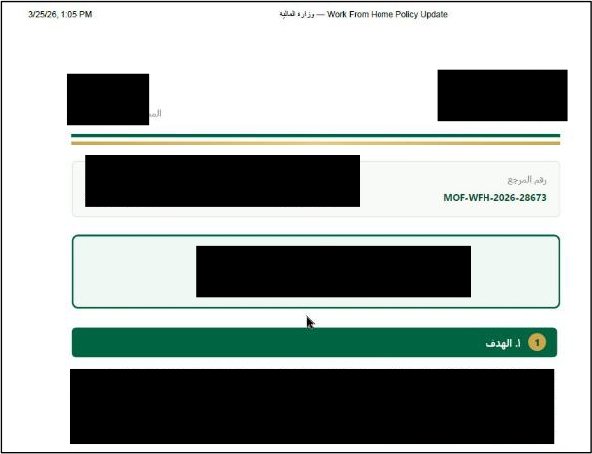
The execution flow is a masterclass in social engineering and technical evasion. When a user interacts with the shortcut, two simultaneous actions occur: the decoy document opens (often a realistic “Work From Home Policy” tailored to local regional contexts), and the Intel binary is launched. During the initialization phase, the .NET runtime automatically looks for a configuration file matching the executable’s name in the local directory.
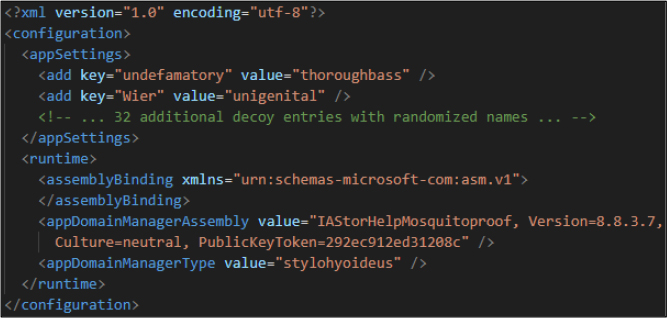
The attackers exploit this by providing a “poisoned” IAStorHelp.exe.config file. This file redefines the AppDomainManager property, pointing it to a malicious, unsigned DLL (in this case, IAstorHelpMosquitoproof.dll) and a specific class named stylohyoideus. Because the runtime prioritizes these config settings for initialization, the malicious code gains control immediately. Crucially, since the .NET runtime does not strictly enforce code-signing requirements for assemblies loaded through this specific configuration path, the unsigned DLL effectively “rides” the signature of the Intel host.
Evasion: Defeating Sandboxes and Heuristics
Once the environment is established, the framework employs several layers of defensive evasion to frustrate automated analysis:
- Computational Delay: To bypass sandbox timeout limits, the malware avoids standard “sleep” calls, which are easily flagged. Instead, it executes a 60-second, CPU-intensive loop of prime-number calculations to mimic heavy but legitimate processing.
- Heavy Decryption: It utilizes an 892,007-iteration AES key-derivation cycle to decrypt its payload, further exhausting the resources of automated malware analysis engines.
- JIT Trampoline Injection: Rather than using suspicious Windows APIs like
VirtualAllocExorWriteProcessMemory, the malware utilizes a Just-In-Time (JIT) “trampoline” technique. It forces the .NET runtime to generate executable code in memory, then overwrites that specific region with shellcode, executing it via a function pointer. This minimizes the telemetry footprint left in memory.
C2 Architecture: CloudFront Domain Fronting
The malware’s command-and-control (C2) infrastructure leverages Amazon CloudFront to perform domain fronting. By routing traffic through a trusted CDN, the malicious communication is masked as standard HTTPS traffic directed toward legitimate AWS services. This makes IP-based blocking nearly impossible and allows the malware to evade many network-level inspection tools.
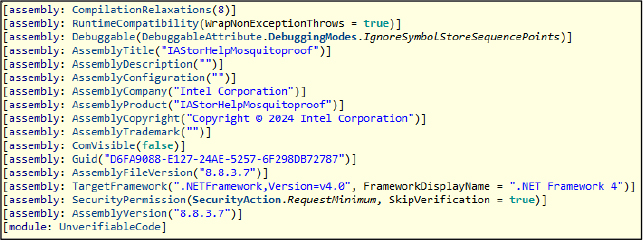
The framework is highly modular, acting as a plugin platform. It can dynamically pull new capabilities—such as credential harvesting, keylogging, or screen capture—directly into memory. To further blend in, the malware’s assembly metadata is spoofed to include legitimate-looking company names, versions, and identifiers.
Defensive Strategies and Recommendations
Detecting Operation PhantomCLR requires moving beyond signature-based detection toward behavioral analysis. Organizations should prioritize the following:
- Config File Monitoring: Monitor for the appearance of
.configfiles in directories alongside known signed binaries, particularly in user-writable paths (e.g.,\AppData\Local\Temp). - Behavioral Hunting: Audit for
IAStorHelp.exeprocesses that initiate unexpected outbound network connections to CDNs or cloud providers. - Runtime Inspection: Implement detection rules for unusual
AppDomainactivity or the loading of unsigned assemblies within a signed process context. - Hardening: Tighten application allowlisting and leverage EDR capabilities to detect JIT-based memory manipulation and reflective loading techniques.
For real-time intelligence on evolving attacks, security professionals should continuously monitor threat intelligence feeds targeting critical sectors.
Indicators of Compromise (IOCs)
| No | IOCs | Type | Remarks |
| 1 | f2266b45d60f5443c5c9304b5f0246348ad82ca4f63c7554c46642311e3f8b83 | SHA-256 | Block |
| 2 | 4f353b9634509a5e1456e54ccb4ce64c1e6d95094df96048ef79b30cc2fda6cb | SHA-256 | Block |
| 3 | 5d784d3ca02ab0015b028f34aa54bc8c50db39f9671dc787bc2a84f0987043b2 | SHA-256 | Block |
| 4 | 8ba1b0392a8fbfb455c43c4e1408352d0e5fc281148810143a5b64938fb0982f | SHA-256 | Monitor |
| 5 | dp8519iqiftub[.]cloudfront[.]net | Domain | Monitor |
| 6 | dunamis-ethos508-prod-va6-856defacfb833db1[.]elb[.]us-east-1[.]amazonaws[.]com | Domain | Monitor |