Researchers and Developers Targeted in AI-Driven GitHub Supply Chain Attack
A sophisticated AI-generated supply chain attack is targeting researchers, developers, and security professionals through compromised GitHub repositories, according to findings from Morphisec Threat Labs.
The campaign leverages dormant GitHub accounts and polished, AI-crafted repositories to distribute a previously undocumented backdoor known as PyStoreRAT, which has been designed to evade detection and exploit the trust of developers in established repositories.
Attack Methodology
The attackers employed a carefully orchestrated strategy, reactivating dormant GitHub accounts and publishing seemingly legitimate repositories that appeared to be AI-generated tools or utilities, in order to gain the trust of the developer community.
Once these repositories gained traction, threat actors quietly injected the PyStoreRAT backdoor into the codebase, exploiting the trust developers place in established repositories and maximizing the potential impact of the attack.
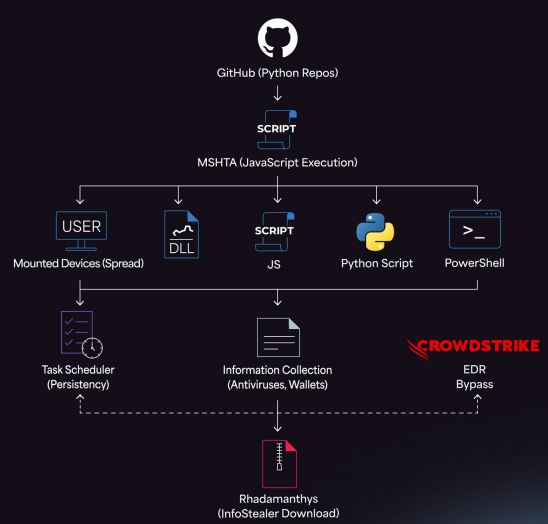
This approach represents a significant evolution in supply chain attacks, where adversaries weaponize the open-source ecosystem by creating convincing fake projects that initially appear benign, in order to target specific audiences and maximize their impact.
By targeting researchers and developers who frequently download and test new tools, the campaign maximizes its potential impact within the technology sector, highlighting the need for increased vigilance and security measures.
PyStoreRAT is a sophisticated backdoor that distinguishes itself from conventional malware loaders through its advanced capabilities, including comprehensive system profiling and the deployment of multiple secondary payloads tailored to the environment.
The backdoor also includes detection logic specifically designed to identify endpoint detection and response (EDR) solutions, such as CrowdStrike Falcon, and alters its execution path to evade analysis and maintain persistence when security tools are detected.
Furthermore, PyStoreRAT employs rotating command-and-control (C2) infrastructure, making it significantly harder for defenders to block communications and track the threat actors, and highlighting the need for advanced security measures to detect and prevent such attacks.
Morphisec researchers have identified Russian-language indicators within the malware code and associated infrastructure, suggesting a potential link to Russian threat actors.
The campaign’s use of GitHub cluster mapping techniques to identify and target specific developer communities suggests a well-resourced and coordinated operation, highlighting the need for increased collaboration and information sharing between security teams and researchers.
Morphisec has published indicators of compromise (IOCs) to assist security teams in detecting and defending against this threat, and organizations are advised to scrutinize GitHub repositories before integrating code, implement enhanced monitoring for suspicious repository activity, and validate the authenticity of seemingly AI-generated projects.