The Core of AI Safety: A Systemic Vulnerability in Anthropic’s MCP Protocol
On April 15, 2026, a critical discovery was made regarding the Model Context Protocol (MCP). Research by OX Security reveals a fundamental, systemic flaw affecting over 150 million downloads and up to 200,000 servers. This isn’t a simple coding error; it is an architectural risk embedded directly into the foundation of the AI ecosystem.
The vulnerability grants attackers the ability to execute arbitrary Remote Code Execution (RCE) on any system running a vulnerable MCP implementation. This means the potential for sensitive data theft, internal database access, and exposure of API keys is not hypothetical—it is systemic.
Unlike traditional software exploits that target a specific line of code, this issue stems from a design decision baked into Anthropic’s official SDKs for Python, TypeScript, Java, and Rust. Consequently, any developer building on the MCP framework unknowingly inherits this exposure through the software supply chain.
The Four Faces of the Attack Vector
OX Security’s investigation identified four distinct exploitation families, ranging from subtle UI injection to direct system takeover:
- Unauthenticated UI Injection: Found within popular AI frameworks.
- Hardening Bypasses: Exploits that bypass protections in environments like Flowise.
- Zero-Click Prompt Injection: A direct attack on AI IDEs, specifically targeting Windsurf and Cursor.
- Malicious Marketplace Distribution: Evidence suggests that 9 out of 11 MCP registries were successfully compromised with malicious payloads.
Practical testing confirmed successful command execution on six live production platforms. Critical vulnerabilities were also identified in industry staples like LiteLLM, LangChain, and IBM’s LangFlow.
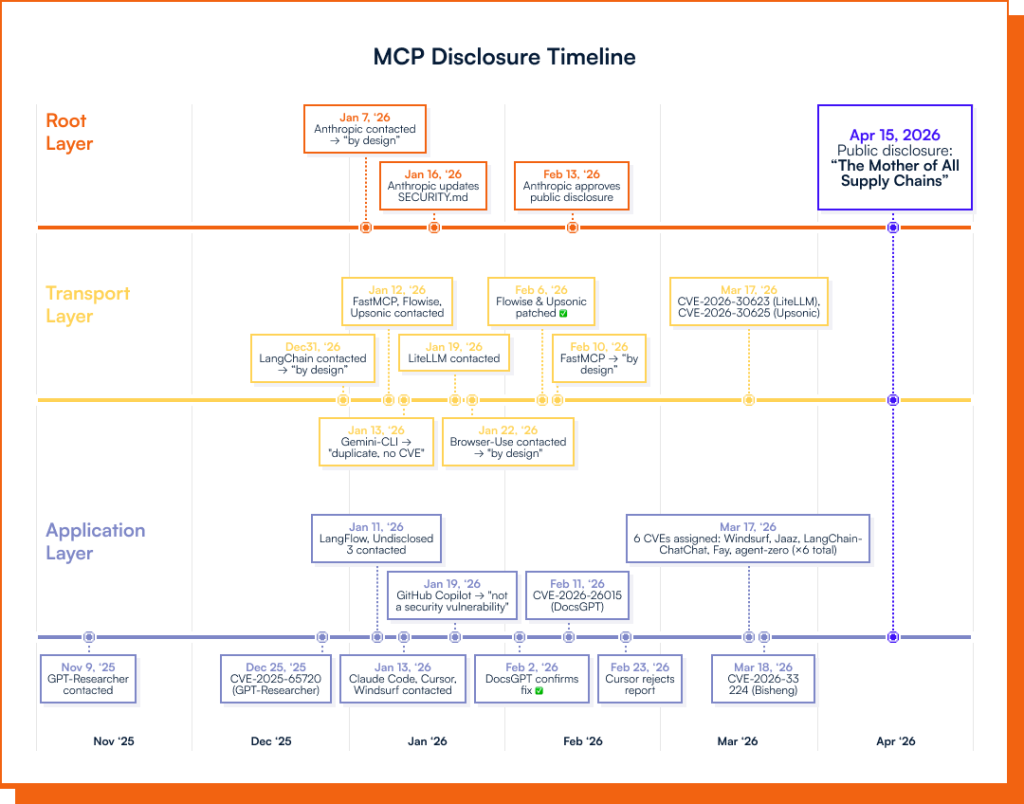
These findings culminated in the issuance of at least 10 CVEs, several of which are rated Critical. The affected products include:
- CVE-2026-30615: Windsurf: Zero-click prompt injection leading to local RCE (Critical, Reported)
- CVE-2026-30623: LiteLLM: Authenticated RCE via JSON config (Critical, Patched)
- CVE-2026-30617: Langchain-Chatchat: Unauthenticated UI injection (Critical, Reported)
- CVE-2025-65720: GPT Researcher: UI injection and reverse shell (Critical, Reported)
- CVE-2026-30618: Fay Framework: Unauthenticated Web-GUI RCE (Critical, Reported)
The “Expected” Response
Following the disclosure, OX Security engaged with Anthropic to propose root-level patches. These changes would have immediately shielded millions of downstream users. However, the response was notable for its absence of urgency; Anthropic reportedly characterized the behavior as “expected,” declining to force a fix on the protocol level.
Despite over 30 responsible disclosures and the filing of more than 10 High/Critical CVEs, the researchers note that the root cause remains unaddressed at the protocol level.
What Organizations Should Do Now
Given the architectural nature of this flaw, developers and DevOps teams must adopt a more defensive posture immediately:
- Restrict Public Access: Block public internet access to AI services connected to sensitive APIs and databases.
- Treat Input as Untrusted: Treat all external MCP configuration input as untrusted data, never allowing raw user input to reach `StdioServerParameters` or similar functions.
- Verify Sources: Install MCP servers only from verified sources, such as the official GitHub MCP Registry.
- Sandboxing: Run MCP-enabled services inside sandboxed environments with restricted permissions.
- Monitor Activity: Vigilantly monitor all tool invocations for unexpected background activity or attempts at data exfiltration.
- Upgrade Immediately: Upgrade all affected services and disable unpatched versions until fixes are available.
Fortunately, OX Security has acted as a bulwark for the community, shipping new protections that detect improper use of STDIO-based MCP configurations in AI-generated code and flag existing vulnerable configurations as actionable findings.
The researchers conclude with a call to action for the industry. With Anthropic recently unveiling Claude Mythos – a tool aimed at securing the world’s software – they must apply that same standard to their own MCP architecture. A truly “Secure by Design” approach requires fixing the foundations before the towers can rise.