The Evolution of Deception: Unmasking North Korean ‘Laptop Farms’ and Remote Work Infiltration
North Korean threat actors are refining a high-stakes social engineering playbook, leveraging the global shift toward remote work to bypass international sanctions and infiltrate high-value organizations. By deploying sophisticated “fake IT worker” personas, these state-sponsored actors are not merely seeking employment; they are establishing persistent beachheads within corporate networks to generate illicit revenue and conduct espionage.
A recent deep-dive investigation, catalyzed by the forensic work of cryptocurrency researcher ZachXBT, has pulled back the curtain on the technical infrastructure sustaining these deceptive operations.The investigation centered on the domain luckyguys[.]site, which was identified as a hub for suspicious payment flows linked to DPRK-affiliated operatives. Technical analysis revealed that the domain resolves to the IP address 163.245.219[.]19. Upon performing a longitudinal study of network traffic, researchers examined a 30-day window of connectivity, uncovering telemetry that mirrors the signature patterns of known North Korean cyber operations.
The VPN telemetry associated with this IP address provides a startling look into their anonymization strategies. The distribution of connections shows a heavy reliance on specific privacy tools:
- Astrill VPN: 37.5% of connections
- Mullvad VPN: 32.25% of connections
- Proton VPN: 6.25% of connections
The dominance of Astrill VPN is a critical forensic indicator. Previous intelligence from GitLab and Flare.io has consistently flagged this specific provider as a preferred tool for DPRK-linked actors attempting to mask their geographic origin.
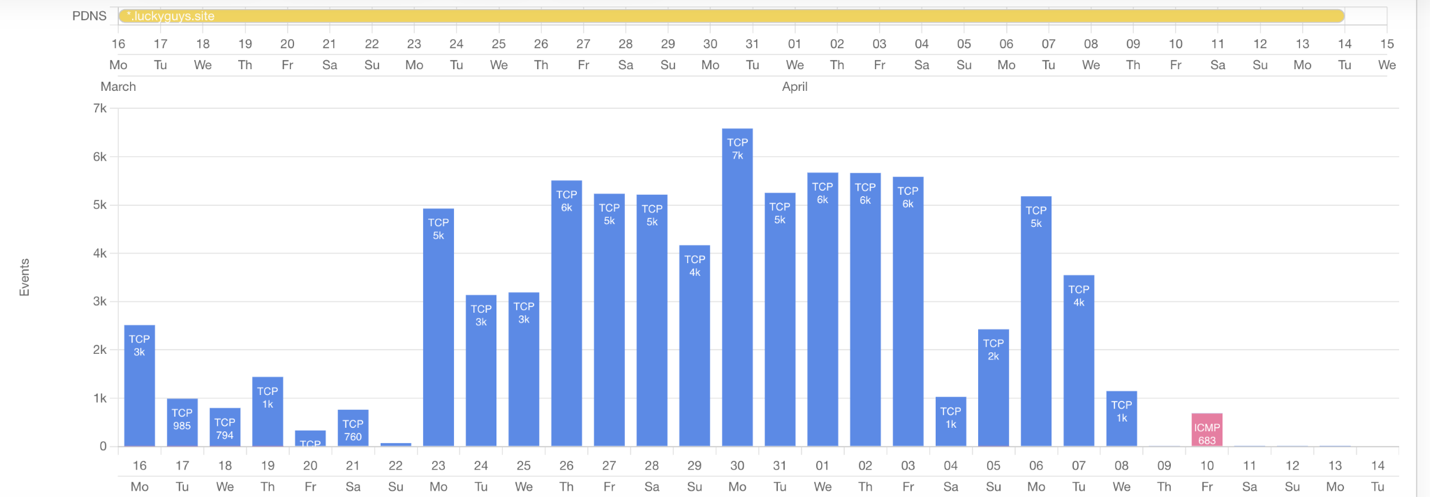
A notable observation in the traffic lifecycle was the “burn-on-detection” behavior: connection volume plummeted immediately following the public disclosure of this infrastructure on April 8. This rapid abandonment is a hallmark of operational security (OPSEC) practiced by advanced persistent threats (APTs) to prevent further attribution.
The Mirage of Legitimacy: Residential IPs and Cloud Integration
One of the most challenging aspects of this campaign is the use of residential IP addresses located in the United States and Latvia. To a standard security filter, these connections appear to be legitimate remote employees. However, deep packet and NetFlow analysis revealed a highly anomalous behavioral profile:
- VPN Tunneling: Consistent, high-frequency use of Astrill VPN from residential nodes.
- Service Profiling: Routine connections to productivity and AI-driven platforms, including Gmail, ChatGPT, and Workana.
The integration of AI tools like ChatGPT aligns with recent reports from Group-IB, which noted that DPRK operators are increasingly utilizing Large Language Models (LLMs) to polish their professional communication and automate technical tasks, making their “fake” personas much harder to distinguish from native English-speaking developers.
Furthermore, the heavy involvement of Workana—a global freelance marketplace—serves as the primary vector for recruitment. As documented by Nisos, these operatives create meticulously crafted professional profiles to secure remote contracts. Once integrated into a company’s workflow, they gain the access necessary to exfiltrate intellectual property or funnel corporate payroll directly into sanctioned state coffers.
Infrastructure Expansion and Detection Strategies
Forensic examination of X.509 certificates associated with luckyguys[.]site uncovered a secondary footprint at IP 216.158.225[.]144. Much like the primary IP, this secondary node showed a sharp cessation of activity following public attribution, suggesting a highly coordinated and distributed “laptop farm” model where assets are rotated frequently to maintain resilience.
Threat Mitigation Recommendations:
For security operations centers (SOC) and enterprise architects, the following defensive postures are recommended:
- Adopt Zero Trust for Freelancers: Treat residential IPs and third-party contractors with the same scrutiny as untrusted external entities. Do not assume a US-based IP is inherently benign.
- VPN Anomaly Detection: Monitor for “VPN-over-Residential” patterns, where a residential IP is acting as an exit node for a commercial VPN service.
- Audit Third-Party Pipelines: Review the vetting process for remote IT talent, especially those sourced via freelance marketplaces.
- Indicator of Compromise (IoC) Sweeps: Immediately audit network logs for historical or active connections to
163.245.219[.]19and216.158.225[.]144.
The sophistication of this campaign highlights a critical shift: the battlefield has moved from exploiting software vulnerabilities to exploiting the very human processes of the modern, decentralized workforce.