The Evolution of Evasion: How Phishing is Moving Beyond Malware to High-Fidelity Hosted Flows
The threat landscape is undergoing a fundamental architectural shift. As traditional Phishing-as-a-Service (PhaaS) platforms face increasing pressure from law enforcement, attackers are pivoting away from risky, static malware attachments toward highly resilient, hosted phishing infrastructures. By blending social engineering with sophisticated technical evasion, threat actors are creating “friction-heavy” attack chains designed to bypass both automated security filters and human intuition.
Recent telemetry from Microsoft Threat Intelligence reveals that the majority of modern threats are now link-based. In Q1 2026, link-based attacks accounted for a staggering 78% of the total volume, signaling a clear preference for remote hosted infrastructure over traditional file-based payloads. While malicious attachments (such as large HTML or ZIP files) saw a spike in January at 19%, they stabilized to 13% by March as credential harvesting via hosted links became the dominant objective.
During the first quarter of 2026, the sheer scale of these operations was immense, with approximately 8.3 billion email-based phishing threats recorded. Although monthly volumes saw a slight easing from 2.9 billion in January to 2.6 billion in March, the underlying sophistication of the payloads has only intensified.

A notable example of this shifting pattern is the Tycoon2FA platform. After a significant 54% decline in volume from December 2025 to January 2026, the platform demonstrated the inherent resilience of modern PhaaS ecosystems. Rather than collapsing under pressure, these actors are increasingly investing in sophisticated backends that can withstand targeted disruptions.
Advanced Evasion: CAPTCHA Gates and ClickFix Tactics
One of the most significant developments in Q1 was the rise of CAPTCHA-gated phishing. This is a dual-purpose tactic: it serves as a social engineering layer to build false trust and, more importantly, acts as a technical shield against automated sandbox analysis. By forcing a user to complete a “verification” step, attackers prevent automated security scanners from seeing the final phishing landing page, effectively hiding the malicious intent behind a wall of legitimate-looking interaction.
The data shows an explosive trend here: after a brief dip in early Q1, CAPTCHA-gated phishing volumes surged by 125% in March, reaching 11.9 million attacks—the highest volume seen in the past year.

Complementing this is the “ClickFix” methodology. In these campaigns, attackers hijack the user’s sense of troubleshooting. Users are prompted with a fake error message and instructed to copy and execute specific PowerShell or shell commands—often via the Windows “Run” dialog—to “fix” the issue. This technique is particularly dangerous because it transforms the victim into the unwitting executor of the payload, rendering traditional “don’t click links” training largely obsolete.
Furthermore, QR code phishing (Quishing) has emerged as the fastest-growing vector. Volumes climbed from 7.6 million in January to 18.7 million in March, a 146% increase. By embedding QR codes within PDFs or email bodies, attackers move the attack surface from the secured corporate workstation to the less-managed, highly personal mobile device, effectively bypassing URL inspection engines.
The Resilience of the PhaaS Ecosystem
The persistence of these threats is fueled by a robust PhaaS economy. Even when major operations like Tycoon2FA face coordinated disruption by entities such as Europol and Microsoft’s Digital Crimes Unit, the actors prove remarkably agile. Tycoon2FA, for instance, responded to disruption by rotating away from major providers like Cloudflare and pivoting toward new Top-Level Domains (TLDs) and heavy use of .RU registrations.

New players are also entering the fray. While platforms like Kratos continue to evolve, new threats like EvilTokens are gaining traction. EvilTokens specifically targets OAuth device flows, using AI-enabled techniques to obtain long-lived session tokens, which are far more valuable for Business Email Compromise (BEC) than simple passwords.
Strategic Defense: Moving Beyond the Perimeter
The data is clear: by the end of Q1, nearly 95% of all payload-based attacks were aimed at credential theft, while traditional malware deliveries dropped to just 5–6%.
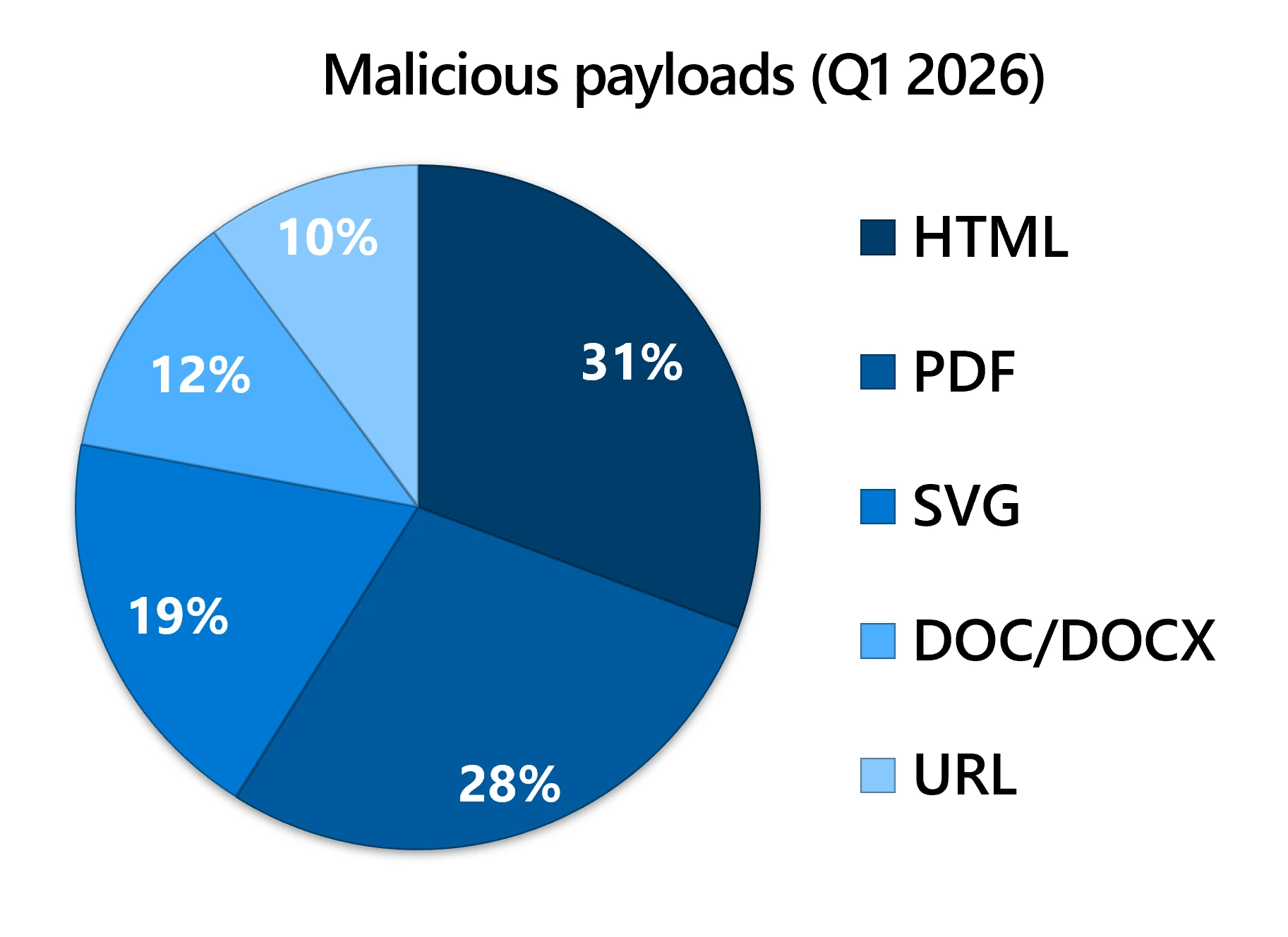
To defend against this highly orchestrated landscape, organizations must move away from a “file-centric” security model and toward a “layered identity” model. Key priorities should include:
- Advanced Email Security: Leverage tools like Microsoft Defender for Office 365, specifically utilizing Safe Links, Safe Attachments, and Zero-hour Auto Purge (ZAP) to catch and retroactively remove links that lead to CAPTCHA-gated or ClickFix-style flows.
- Phishing-Resistant Identity: Transitioning to password-less authentication and FIDO2-based MFA is critical. Standard MFA is increasingly vulnerable to the session-token theft used by modern PhaaS platforms.
- Conditional Access: Implementing strict conditional access policies can mitigate the risk of stolen credentials by ensuring that even a valid token is useless if it doesn’t originate from a known, compliant device or network.
- Modernized User Awareness: Security training must evolve. Users need to be specifically coached on the dangers of scanning QR codes in emails, interacting with unexpected CAPTCHAs, and—most importantly—the absolute rule that legitimate security verification will never require copying and pasting command-line scripts.