The Shai-Hulud Worm: Unpacking the Weaponization of the npm Supply Chain
The cybersecurity landscape is currently facing a sophisticated shift in how supply chain attacks are executed. Security researchers are sounding the alarm over “Shai-Hulud“, a highly advanced, self-propagating npm worm specifically engineered to harvest high-value developer credentials.
Targeting environments ranging from local workstations to highly orchestrated cloud infrastructures like AWS and Kubernetes, this malware represents a significant escalation in automated credential theft.
Tracked by the SlowMist MistEye threat intelligence platform, the campaign is already being categorized as one of the most impactful npm-based threats in recent history, with hundreds of malicious packages identified in the wild. Crucially, researchers have determined that this was not a spontaneous data leak; rather, it was a calculated “capability diffusion” strategy. By releasing the source code, the threat actor effectively transformed a bespoke cyber weapon into a standardized toolkit for the global attacker community.
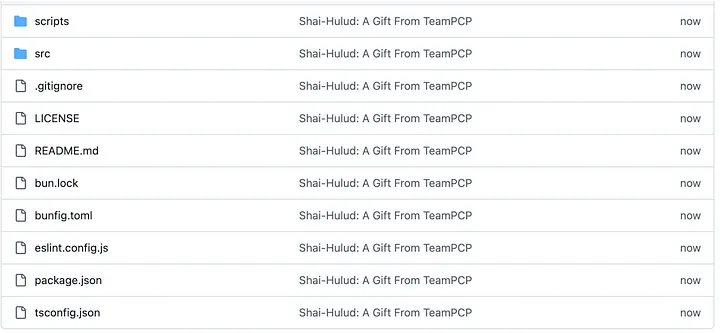
The group behind this, known as TeamPCP, did not simply leak code; they provided a turnkey operational package. Utilizing compromised GitHub accounts, they distributed entire repositories complete with deployment instructions, provocatively labeling their projects with the phrase “A Gift From TeamPCP.”
According to a detailed technical report by SlowMist, the situation reached a tipping point on May 12, when TeamPCP released the full Shai-Hulud source code on GitHub. Since then, analysts have observed a rapid proliferation of forks and variants, indicating that the malware is being quickly integrated into the repertoires of various copycat threat actors.
Technical Analysis: Targeted Credential Harvesting and Propagation
While Shai-Hulud is optimized to exploit GitHub Actions CI/CD pipelines, its payload capabilities extend deeply into the developer’s local ecosystem. The malware is designed for automated execution via npm lifecycle scripts, initiating a multi-vector harvesting process immediately upon installation.
The malware’s reconnaissance and exfiltration engine targets several critical vectors:
- Local Developer Environments: Extraction of GitHub CLI tokens and local configuration files.
- Cloud Infrastructure: Intercepting AWS credentials via the Instance Metadata Service (IMDS) and web identity tokens.
- Orchestration Layers: Scavenging Kubernetes service account tokens from standard filesystem paths.
- Runtime Secrets: Capturing environment variables and sensitive API keys stored in memory or config files.
To ensure data integrity and evade simple network inspection, collected intelligence is encrypted using AES-256-GCM before being exfiltrated to a Command-and-Control (C2) server. In a clever bit of social engineering, the C2 infrastructure utilizes the domain git-tanstack[.]com, masquerading as the legitimate TanStack project ecosystem.
What distinguishes Shai-Hulud from standard info-stealers is its autonomous propagation mechanism. Upon successfully capturing valid npm registry tokens, the worm attempts to hijack legitimate packages by injecting malicious preinstall scripts and republishing the compromised versions. This creates a “wormable” effect, where the infection travels silently through the dependency tree of unsuspecting downstream users.
Furthermore, the malware exhibits advanced evasion techniques targeting modern AI-assisted development workflows. It specifically targets configuration files for tools like Claude Code (e.g., ~/.claude.json), injecting execution hooks to run arbitrary code. To bypass AI-driven security scanners, it employs a specialized “Anthropic Magic String,” demonstrating a high level of sophistication regarding contemporary DevOps and AI-integrated development environments.
The malware’s internal architecture features a highly efficient regex engine specifically tuned to identify high-entropy strings, such as GitHub Personal Access Tokens (PATs), npm tokens, and GitHub App JWTs. The modular, professional-grade code suggests an enterprise-level development standard. Interestingly, the codebase contains logic to skip infection on systems using Russian language locales, a common indicator of origin-based avoidance seen in previous sophisticated APT campaigns.
Indicators of Compromise (IoCs)
Security operations teams should monitor for the following patterns and artifacts. Note: All domains and IP addresses have been defanged (e.g., [.]) for safety. Only re-fang these indicators within a controlled, isolated environment such as a SIEM or a dedicated threat intelligence platform.
| Type | IOC |
|---|---|
| C2 Domain | git-tanstack.com |
| C2 Path | /router |
| Script Names | opensearch_init.js, ai_init.js |
| Package Name | voicefromtheouterworld |
| GitHub Search | “A Gift From TeamPCP” |
| Suspicious Accounts | agwagwagwa, headdirt, tmechen |
As the Shai-Hulud worm continues to evolve through community-driven modifications, organizations are advised to implement strict dependency pinning, utilize software composition analysis (SCA) tools, and enforce the principle of least privilege for all CI/CD service accounts.