Weaponizing Modularity: Analyzing the ‘PamDOORa’ Backdoor Technique in Linux Environments
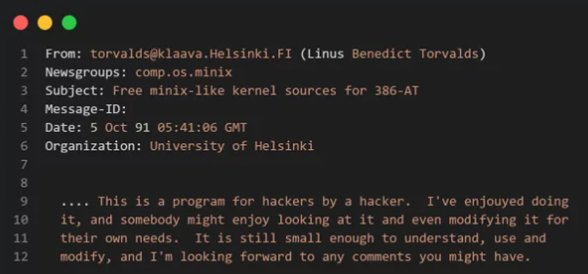
In the world of Linux administration, modularity is considered a crowning achievement. Since Linus Torvalds introduced the kernel in 1991, the philosophy of “do one thing and do it well” has allowed for a highly customizable ecosystem.
However, as security researchers from the Group-IB DFIR team have recently demonstrated, this very flexibility can be turned against the system. A novel persistence technique, dubbed PamDOORa, is currently exploiting the Pluggable Authentication Modules (PAM) framework to stealthily harvest SSH credentials and maintain a long-term foothold on compromised hosts.
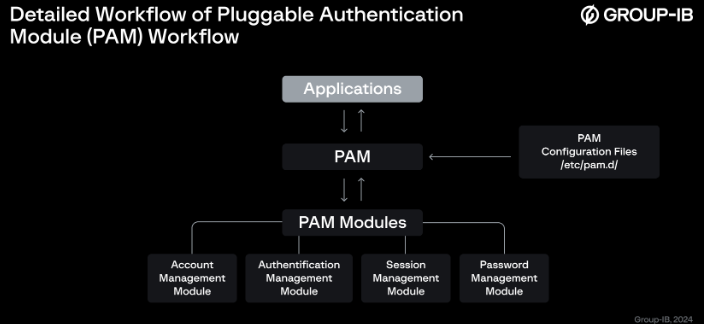
To understand why this attack is so effective, one must understand the role of PAM. PAM acts as a sophisticated intermediary layer between applications—such as sshd, login, su, and passwd—and the underlying authentication mechanisms. By decoupling authentication logic from the application itself, PAM allows administrators to manage complex access policies centrally without rewriting application code.
The PAM framework operates through four distinct module types:
- Authentication: Verifies the identity of the user.
- Account Management: Determines if the user is allowed to access the system at the current time.
- Password Handling: Manages password updates and complexity requirements.
- Session Control: Handles the setup and teardown of user sessions.
Each module is governed by control flags—required, requisite, sufficient, and optional—which dictate the flow of the authentication process. While PAM is highly secure by design, it processes sensitive authentication data (sometimes in plaintext) as it passes through these modules, creating a high-value target for adversaries.
The Anatomy of the Attack: Weaponizing pam_exec
The core of this technique lies in the abuse of the pam_exec module. In a legitimate administrative context, pam_exec is an invaluable tool used to trigger external scripts during authentication events—for instance, to send a notification to a Slack channel whenever a user changes their password.
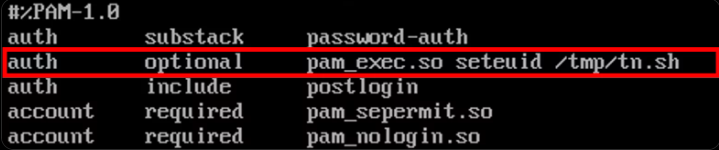
Threat actors have discovered that by injecting a malicious entry into critical PAM configuration files, such as /etc/pam.d/sshd, they can force the system to execute arbitrary code during every SSH attempt. This isn’t just a theoretical risk; in a PamDOORa scenario, the attacker uses this module to trigger a hidden script that acts as a silent data harvester.
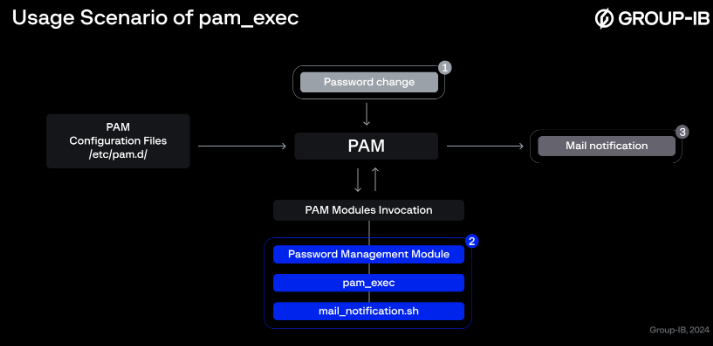
The workflow is chillingly efficient. Whenever an SSH login attempt is made, the malicious script captures critical environment variables, including:
PAM_USER: The username being targeted.PAM_RHOST: The remote IP address of the connection.PAM_SERVICE: The service being accessed (e.g., sshd).
This metadata is then exfiltrated to a remote Command-and-Control (C2) server, often utilizing ubiquitous tools like netcat (nc) to bypass traditional firewall scrutiny.
The Stealth Factor: Why Detection Fails
What makes PamDOORa particularly dangerous is its use of the optional control flag. By marking the malicious module as optional, the attacker ensures that even if the script fails or encounters an error, the actual authentication process continues uninterrupted. The user logs in successfully, never suspecting that a background process just sent their metadata to a third party.
Furthermore, this technique leaves a minimal forensic footprint. Standard system logs (like auth.log or secure) will record a “failed login” or a “successful login,” but they rarely log the internal execution of a PAM module. To a sysadmin, a flurry of failed logins looks like a standard brute-force attack, while the silent exfiltration happening in the shadows remains completely invisible.
Defensive Strategies and Mitigation
As Linux continues to underpin the global cloud infrastructure, defending against “living-off-the-land” techniques like PamDOORa is critical. Organizations should move beyond simple password policies and implement a multi-layered defense:
- File Integrity Monitoring (FIM): Use tools like Tripwire or
AIDEto monitor/etc/pam.d/for unauthorized changes. Any modification to these files should trigger an immediate high-priority alert. - Hardened Access Controls: Leverage Mandatory Access Control (MAC) systems like SELinux or AppArmor to restrict which processes are permitted to execute scripts or initiate outbound network connections.
- Audit Configuration Files: Regularly audit PAM configurations to ensure no
pam_execmodules are present unless strictly documented and required for business logic. - Enhanced Endpoint Detection: Deploy EDR (Endpoint Detection and Response) solutions capable of monitoring process lineage and detecting anomalous outbound connections from system-level services.
The PamDOORa discovery is a sobering reminder: in highly modular systems, the very features designed to provide flexibility can become the most potent tools for an adversary.