The 2026 Secure Boot Transition: Why Certificate Expiry is a Silent Security Risk
There is a common misconception that the upcoming expiration of Microsoft’s Secure Boot certificates will “brick” hardware. This is not the case. However, the technical reality is arguably more insidious: unmigrated systems will experience a “silent freeze” of their security posture. While devices will continue to boot, they will lose the ability to receive critical DB/DBX updates, effectively locking Windows and Linux fleets out of future boot-level protections.
On June 27, 2026, the Microsoft Corporation KEK CA 2011—the key used to authorize DB/DBX updates via Windows Update—will reach its end of validity. Simultaneously, the Microsoft UEFI CA 2011, used to sign third-party bootloaders and shims, will also expire.
The transition concludes in October 2026, when the Microsoft Windows Production PCA 2011 (which signs the Windows Boot Manager and pre-OS components) expires, completing the shift to the modern 2023 certificate family.
It is vital to understand that Secure Boot does not inherently enforce certificate expiration at the moment of boot. Consequently, devices will continue to start using the already-enrolled 2011 CAs. The danger lies in the operational paralysis: once the KEK path breaks, devices can no longer accept new Secure Boot certificate updates or DBX revocations, freezing their trust and revocation state in time.
The 2011 Certificate Lifecycle and 2023 Successors
The transition is driven by three distinct certificates, each performing a specialized role within the UEFI hierarchy:
| Certificate | UEFI Store | Expiry | Primary Function | 2023 Successor |
|---|---|---|---|---|
| Microsoft Corporation KEK CA 2011 | KEK | June 2026 | Authorizes DB/DBX updates via Windows Update | Microsoft Corporation KEK CA 2023 |
| Microsoft Corporation UEFI CA 2011 | DB | June 2026 | Signs Linux shim and 3rd-party option ROMs | Microsoft UEFI CA 2023 / Option ROM CA 2023 |
| Microsoft Windows Production PCA 2011 | DB | Oct 2026 | Signs Windows Boot Manager & pre-OS components | Windows UEFI CA 2023 |
Crucially, none of these certificates serve as the Platform Key (PK). OEMs such as Dell, HP, Lenovo, and Supermicro retain ownership of the PK at the apex of the Secure Boot chain. The expiry does not destroy the chain of trust itself, but it does sever the mechanism required to update that chain through Microsoft’s automated servicing channels.
An architectural improvement in the 2023 family is the de-monolithization of the UEFI CA. While the 2011 version was a single entity, the 2023 version splits responsibilities between OS bootloaders and hardware option ROMs. This provides enterprises with granular control, allowing them to trust a Linux shim while explicitly excluding third-party option ROM CAs in hardened environments.
The Impact on Enterprise Fleets
As noted by Eclypsium, nearly every Windows device shipped since the inception of Secure Boot—including Windows 10, 11, and various Server editions—relies on these 2011 certificates. Only newer Copilot+ PCs ship with the 2023 chain natively.
For Linux administrators, the stakes are high. Linux distributions utilizing shim depend on the Microsoft UEFI CA 2011. To avoid boot failures, administrators must ensure shim builds are re-signed with the 2023 CA before any old entries are revoked. Furthermore, virtualization admins must remember that virtualization stacks (VMware ESXi, Hyper-V, KVM/OVMF) maintain their own virtual UEFI stores; updating a host does not automatically migrate the Secure Boot state within guest VMs.
The Hardware Risk: OEM coverage is inconsistent. While modern platforms (like recent Dell PowerEdge generations) include 2023 certificates via BIOS updates, older “end-of-service” hardware may have no firmware path for migration. In a worst-case scenario—such as a CMOS reset or board replacement that reverts to factory defaults—these devices may become unbootable. Recovery would require the use of SecureBootRecovery.efi alongside a BitLocker recovery key.
The Security Gap: A Haven for Bootkits
The 2026 deadline coincides with an era of sophisticated boot-level exploitation. Vulnerabilities like BootHole and BlackLotus are mitigated through DBX (revocation list) updates. If a device’s KEK expires, it can no longer receive these revocations. This creates a “permanent safe haven” for bootkits: the device will trust everything that was valid in 2026, but it will be fundamentally incapable of learning to distrust new threats discovered in 2027 and beyond.
Even the NSA has issued guidance emphasizing that the presence of a TPM and BitLocker does not guarantee a secure boot configuration. Operators are urged to query UEFI variables directly to ensure the PK/KEK/DB/DBX configuration matches an expected baseline.
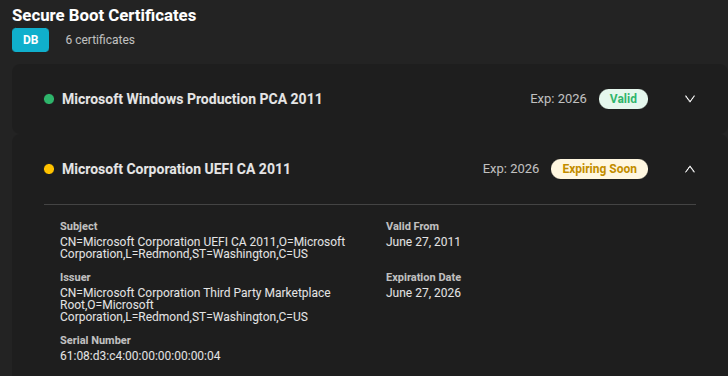 Detection of the expiring Microsoft Corporation UEFI CA 2011 certificate affecting Linux and Windows systems.
Mitigation and Visibility
To manage this transition, Microsoft recommends a specific sequencing rule: apply OEM firmware updates that embed 2023 keys before relying on Windows Update alone. This prevents the loss of new certificates during a subsequent BIOS reset.
The primary challenge for most organizations is visibility. Traditional EDR agents and vulnerability scanners rarely enumerate UEFI variables, leaving IT teams blind to which assets are still tethered to the 2011 KEK. Without granular visibility into the PK, KEK, DB, and DBX contents, organizations cannot accurately assess their exposure to threats like Bombshell or BlackLotus.
By proactively inventorying these variables and comparing them against the UEFI Forum’s published revocation lists, enterprises can transform this 2026 deadline from a potential outage into a controlled, high-integrity migration.