Analyzing GoFlateLoader: The High-Volume Payload Delivery Mechanism for Modern Infostealers
In the evolving landscape of malware distribution, GoFlateLoader has emerged as a prominent Golang-based delivery vehicle. While its architecture may appear rudimentary at first glance, it has become a highly effective mechanism for deploying a diverse array of sophisticated infostealers, including Lumma, Vidar, StealC, Amatera, and Remus.
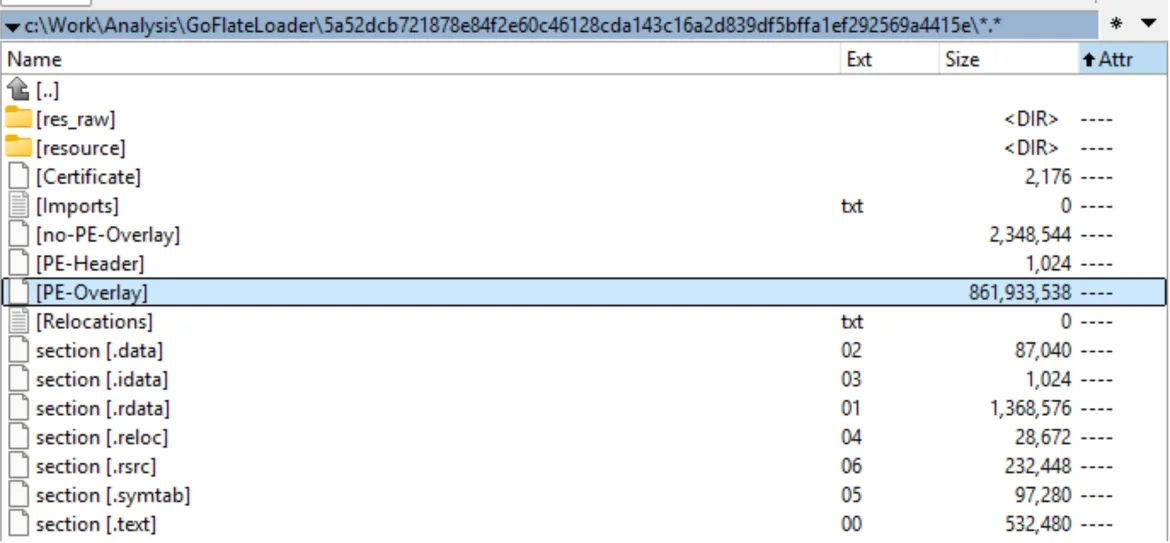
Unlike many modern loaders that employ complex obfuscation, GoFlateLoader’s design is intentionally unpretentious. It lacks typical defensive measures such as anti-debugging, anti-VM environments, API hashing, or advanced control-flow obfuscation. Instead, its operational stealth is derived from a “brute force” approach to evasion: the use of massive PE (Portable Executable) overlays. By appending enormous amounts of data to the binary, attackers inflate the file size to frustrate automated sandbox analysis and bypass EDR detection thresholds.
From a functional standpoint, the loader operates through a deterministic execution flow. It extracts an encoded payload blob from the .rdata section, transfers it to the stack, and executes a multi-stage byte-level decoding routine to reconstruct a valid PE file. Once reconstructed, the loader parses the essential PE headers—including the image base, section table, and data directories—before allocating an RWX (Read, Write, Execute) memory region via VirtualAlloc to host the malicious payload.
A critical technical nuance in its execution is the use of Go’s syscall.Syscall as a generic call gate. The loader sets a trap pointer to the payload’s entry point and utilizes hardcoded dummy arguments (1, 2, 3, 4). This specific pattern—using syscall.Syscall with arbitrary filler arguments—is highly irregular and provides a distinct behavioral signature for threat hunters.
Furthermore, the loader incorporates significant amounts of junk and decoy code. These segments vary between individual builds to complicate static analysis efforts without impacting the actual runtime behavior of the malware.
The Strategy of Size-Based Evasion
Gen Threat Labs has been closely monitoring GoFlateLoader, specifically noting its reliance on extreme file sizes. Samples typically range between 700 MB and 950 MB. These overlays are often filled with null bytes or random padding, which allows the file to compress efficiently for distribution via archives while remaining massive once extracted.
This strategy targets the practical limitations of modern security stacks. Many antivirus and EDR solutions implement size limits for deep scanning or emulation to maintain system performance. Similarly, automated intelligence platforms like VirusTotal impose strict upload caps (currently 650 MB), meaning GoFlateLoader samples often bypass the most common automated scrutiny pipelines.
Gen Threat Labs has identified two primary infection vectors: the distribution of cracked software and a malicious Traffic Distribution System (TDS). In the latter scenario, victims are redirected to landing pages that serve password-protected archives. By displaying the password separately on the webpage, attackers ensure that automated scanners—which lack the ability to scrape and test passwords—cannot inspect the underlying payload.
The loader is architecturally flexible, supporting both x86 and x86-64 builds to match the target environment and the specific infostealer payload intended for deployment.
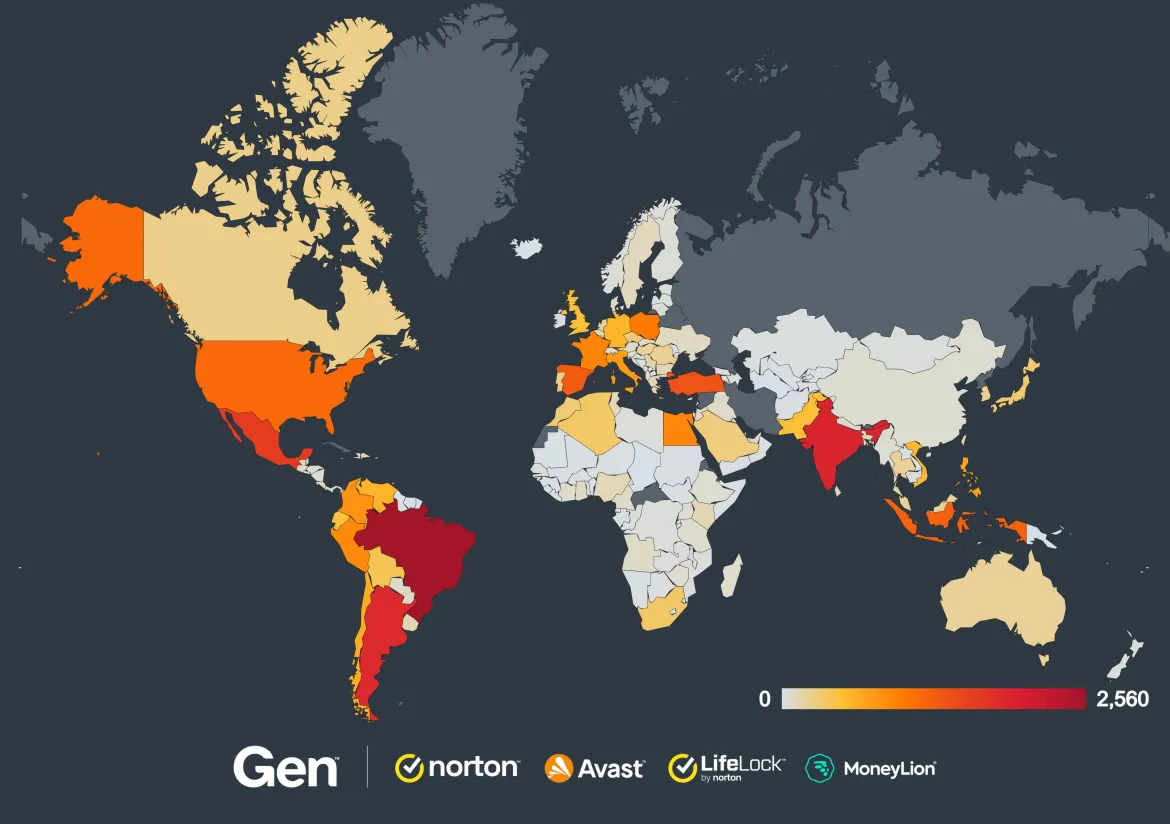
The impact is significant. Since April 2026, Gen Threat Labs has protected over 33,000 unique users from this threat, with high concentrations of activity observed in Brazil, India, Argentina, Mexico, Turkey, and Spain.
Defensive Recommendations
To mitigate the risk of GoFlateLoader infection, organizations should implement the following controls:
- Software Integrity: Enforce strict policies against the installation of cracked or unofficial software.
- Network Filtering: Block known malicious TDS landing pages and suspicious archive-hosting domains.
- Advanced Analysis: Ensure sandboxing pipelines are configured to handle extremely large files and are capable of automated password extraction when credentials are provided in the same context as the download.
- Behavioral Monitoring: Look for the
syscall.Syscallpattern with constant dummy arguments and unusual memory allocations (RWX) following the extraction of large files.
Indicators of Compromise (IoCs)
Note: The following non-archive file hashes exceed 650 MB and are not available via standard public scanning engines like VirusTotal.
- b88c5744975d2abb447aecc6c090fee9f8580413f4612eecdc6ed1973e8a1739 (Archive: GoFlateLoader x64 $\rightarrow$ Remus; pwd: 1234)
- ed5ae7f36453c5a23e9868a5729d67e0549a11f6dea54f5f52d654a8f51d4902 (Archive: GoFlateLoader x64 $\rightarrow$ Remus)
- 841c9297cb8a2e0ff89433d13c05bfc760eb2e98e251cb8fa785d2ad7cbac05f (Archive: GoFlateLoader x86 $\rightarrow$ Amatera)
- ece7c48eb411b24f26762ede83badb4a644c41d5777129381ac2541804d64fc2 (Archive: GoFlateLoader x86 $\rightarrow$ Lumma)
- 421ce2d2f49c23bbe9f60ef3b9cd38d7eb912ce02e56a61837656210069bd9e2 (Archive: GoFlateLoader x64 $\rightarrow$ Vidar)
- 121c2dc793b3873f75a29ec02241f94136de19c049382a50a50d0d5b99507073 (GoFlateLoader x64 $\rightarrow$ StealC)
- 2415db5081cec9bfd14ad6da1a66169fd96f13a49010c319a73d1ed6fafd4efa (GoFlateLoader x64 $\rightarrow$ Vidar)
- d9917ade3b4c125a95b5d3e6343cde26145dfbf569bd7e2a843fd0c6fc8ddc28 (GoFlateLoader x64 $\rightarrow$ Remus)
- 4cf6893756f441522b94b36f10e5de0e47aeed4743f95c51650746d1ecf97e3d (GoFlateLoader x64 $\rightarrow$ SvitStealer)
- 8b89d6c9152d3aab97aadd515ecb69ca72654db2f25425759ba4b646853d737d (GoFlateLoader x86 $\rightarrow$ Lumma)
- 90ce4ff9da23ac150da0a8e17930cab1e369aa349fdc1b65691b70369145664a (GoFlateLoader x86 $\rightarrow$ Amatera)