Gamifying Malice: How Threat Actors are Turning Supply Chain Attacks into a Competitive Sport
The landscape of software supply chain security is facing a disturbing new evolution. Rather than traditional, stealthy infiltrations, a new cybercrime campaign is transforming high-stakes compromises into a public competition. In a collaborative effort, TeamPCP and BreachForums operators have launched a $1,000 bounty contest designed to incentivize hackers to compromise open-source packages.
This initiative, first detailed by Dark Web Informer, represents a strategic pivot in how threat actors operate. By gamifying the attack lifecycle, these groups are not just seeking immediate technical gains; they are actively recruiting new talent and expanding their operational footprint through social engineering and competitive prestige.
The mechanics of the contest are strictly technical: participants are required to utilize a specialized tool dubbed “Shai-Hulud” to successfully inject malicious code or gain unauthorized access to open-source packages. To claim the prize, attackers must submit cryptographic proof of access alongside their verified forum identity.
The reward structure is twofold: a $1,000 payout in Monero (XMR)—chosen for its privacy-centric properties—and significant “reputation points” within the dark web ecosystem. This social capital is often more valuable to aspiring hackers than the liquid currency itself.
Perhaps most concerning is the scoring algorithm. The contest employs a metrics-based leaderboard where points are calculated based on the download counts of the compromised packages. This creates a perverse incentive structure: while targeting a “high-value” package provides a massive score, attackers are also encouraged to execute a high volume of smaller, “low-effort” compromises to maximize their aggregate total.
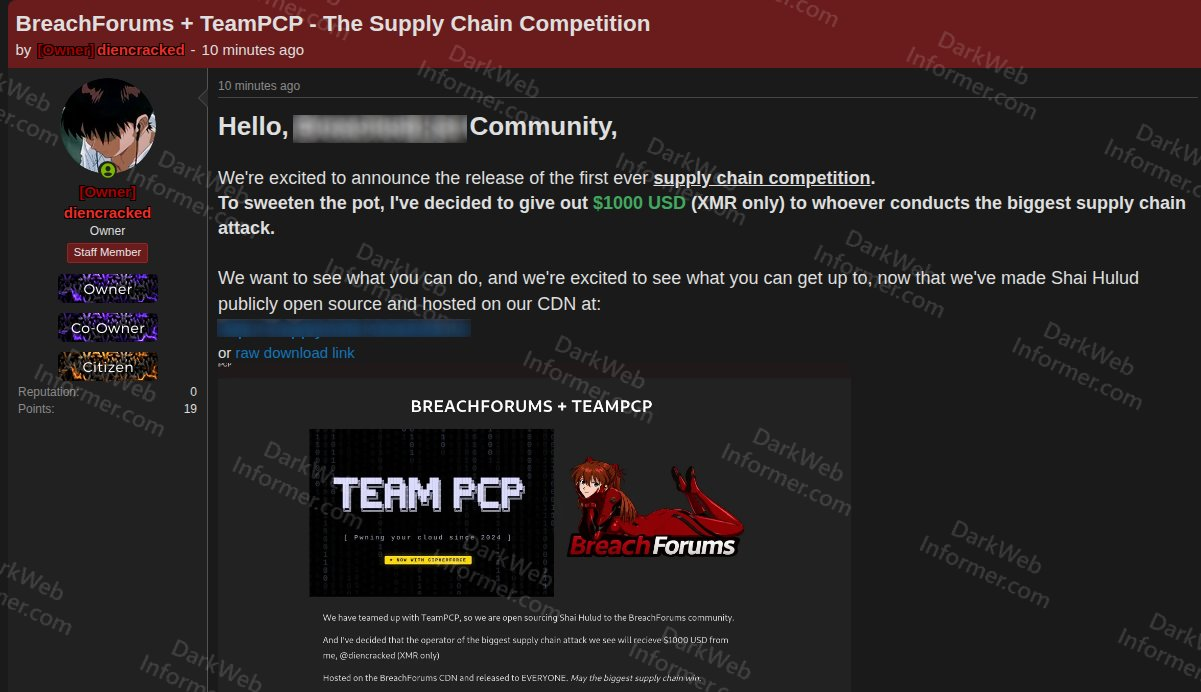
According to intelligence reports, the contest was announced on BreachForums by an account believed to be the forum’s owner, working in tandem with TeamPCP. This alliance between a major criminal forum and a specialized threat group provides the contest with instant legitimacy and a massive distribution network.
By prioritizing download metrics, the campaign shifts the focus from precision-based espionage to broad-spectrum infection. This approach promotes a “spray and pray” methodology, encouraging widespread, indiscriminate malware distribution across various package ecosystems. Security researchers have noted that this behavior closely mirrors worm-like propagation, where the primary goal is to maximize the infection surface area as rapidly as possible.
Analyzing the Economic Discrepancy: High Risk, Low Reward?
At first glance, a $1,000 bounty seems remarkably low for the level of expertise required to compromise a trusted software package. However, the technical “yield” of a successful supply chain attack is astronomical. A single successful compromise can grant an attacker access to:
- CI/CD Pipeline Secrets: Enabling lateral movement through automated build environments.
- Cloud Infrastructure Credentials: Providing direct access to AWS, Azure, or GCP environments.
- Maintainer Tokens: Allowing for further, more sophisticated package hijacking.
- Proprietary Source Code: Leading to intellectual property theft.
- Enterprise Environments: Serving as a beachhead for massive ransomware deployments.
In the professional cybercrime market, these access vectors are sold to ransomware groups and Initial Access Brokers (IABs) for sums far exceeding $1,000. This leads analysts to conclude that the contest is a recruitment funnel. By offering a low barrier to entry and public recognition, TeamPCP is effectively grooming “script kiddies” and lower-tier actors to perform the initial heavy lifting, which is then monetized by more sophisticated syndicates.
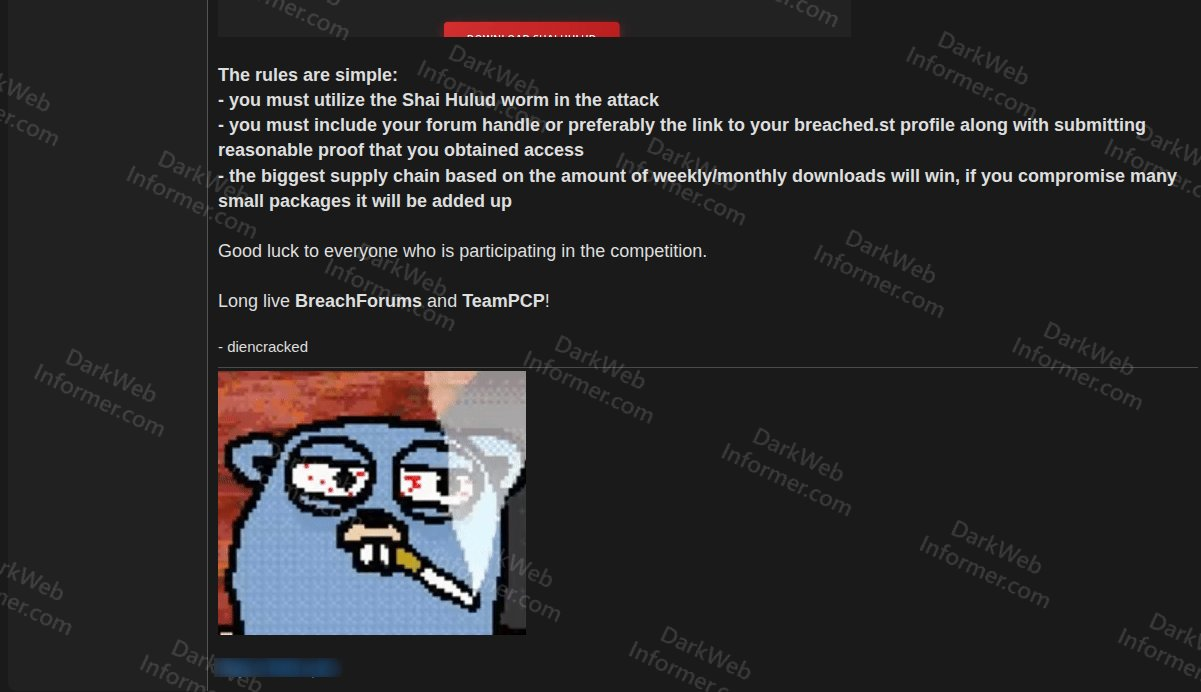
To facilitate this, TeamPCP has taken the aggressive step of releasing the Shai-Hulud attack tool as open-source malware. Hosted on BreachForums infrastructure, the tool’s availability significantly lowers the technical threshold for participating in supply chain attacks. Reports from users on X (formerly Twitter) indicate that a copy of the tool briefly appeared on GitHub before being remediated.
TeamPCP is no stranger to these tactics. Research from Socket indicates the group has a proven track record of targeting critical developer infrastructure, including npm, PyPI, GitHub Actions, Docker images, and OpenVSX extensions. Their methodology is centered on infiltrating “trusted” environments, allowing them to harvest credentials that facilitate downstream attacks on enterprise clients.
The group has also adopted a culture of bravado, frequently mocking modern security defenses as inadequate. This contest appears to be the latest stage in an established pipeline where stolen credentials are funneled to various high-tier threat actors. While attribution remains complex due to overlapping claims with groups like Vect, ShinyHunters, and Lapsus$, the impact of TeamPCP’s recent campaigns has been felt across AI development, manufacturing, and government cloud sectors.
The Bottom Line: While the $1,000 prize may not entice the world’s most elite hackers, it is more than enough to catalyze a wave of reckless, high-volume attacks from less experienced actors. By turning cybercrime into a competitive game, TeamPCP is doing more than just exploiting software vulnerabilities—they are actively engineering a more dangerous and populated threat landscape.